Choosing the right aluminum profile for a building project requires more than selecting a profile based on its dimensions or appearance. Architects, engineers and procurement teams should evaluate the application, load requirements, alloy, profile geometry, wall thickness, tolerances, surface finish, fabrication needs and installation method together.
The correct extrusion is the one that performs its required function while remaining manufacturable, installable and commercially efficient. A profile that looks suitable in a catalog can still create problems when its interfaces, tolerances or structural requirements are not considered.
This guide explains how to select an aluminum profile for architectural and construction applications, when to use a standard profile, when to develop a custom extrusion and which technical parameters should be defined before requesting a quotation.


What Should You Consider When Choosing an Aluminum Profile?
The right aluminum profile should be selected according to the function of the component first, followed by structural requirements, geometry, alloy, wall thickness, tolerance, surface finish, fabrication and production volume.
| Selection Factor | Key Question | Why It Matters |
|---|---|---|
| Application | What will the profile actually do? | Defines the functional and mechanical requirements. |
| Load | Will the profile carry or transfer loads? | Determines stiffness, section geometry and alloy requirements. |
| Geometry | Does the cross-section provide the required interfaces? | Controls structural behavior and assembly compatibility. |
| Alloy & Temper | Is strength or surface performance more important? | Influences mechanical properties, extrusion behavior and finishing. |
| Wall Thickness | What minimum wall thickness can be manufactured reliably? | Affects weight, stiffness, extrusion feasibility and cost. |
| Tolerance | Which dimensions are functionally critical? | Prevents assembly and fit problems. |
| Finish | Will the profile be visible or exposed outdoors? | Determines appearance and surface protection requirements. |
| Fabrication | Will it require cutting, drilling or machining? | Can reduce assembly time and downstream production work. |
| Volume | How many profiles are required? | Influences tooling economics and unit cost. |
1. Start With the Application, Not the Profile Shape
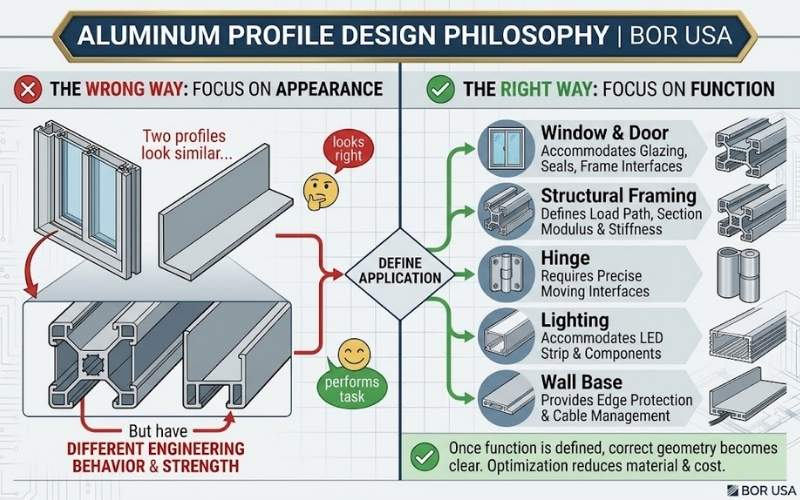
The first question should not be “Which aluminum profile looks right?” It should be “What function must the profile perform?”
This distinction is important because two profiles with similar external dimensions can have completely different engineering behavior.
For example, a window frame profile, a floor transition profile and an aluminum hinge profile may all be relatively compact extrusions. Their functional requirements are nevertheless different.
A window profile must accommodate glazing, seals, frame interfaces and installation tolerances. A floor profile may need to provide a transition, edge protection or connection surface. A hinge profile may require precise interfaces for moving components.
Therefore, define the application before selecting the section.
- Window or door system
- Facade or architectural framing
- Interior partition
- Floor transition or edge protection
- Wall protection or baseboard
- Sliding system
- Furniture or cabinetry
- Lighting integration
- Structural framing
- Custom OEM building component
Once the function is defined, profile geometry becomes much easier to evaluate.
2. Determine Whether the Profile Is Structural or Functional
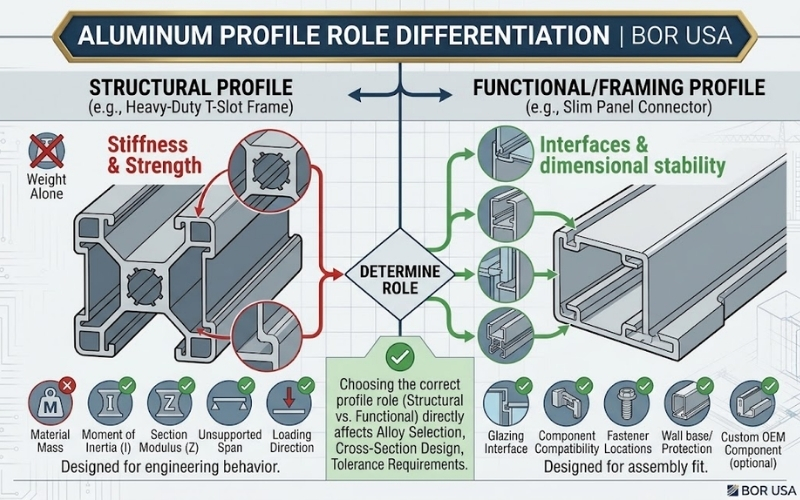
Not every aluminum profile in a building project is a structural member.
This distinction directly affects alloy selection, cross-section design and tolerance requirements.
| Profile Role | Typical Requirement | Primary Design Concern |
|---|---|---|
| Structural | Carry or transfer loads | Stiffness, strength and section geometry |
| Framing | Connect panels, glass or components | Interfaces and dimensional stability |
| Trim | Cover or finish an interface | Appearance and fit |
| Protection | Protect edges or surfaces | Impact resistance and installation |
| Functional | Provide a mechanical or installation function | Geometry and component compatibility |
| Integrated | Combine several functions | Geometry, assembly and manufacturability |
For a structural profile, weight alone is not a sufficient selection criterion.
Engineers should consider the relationship between material mass, moment of inertia, section modulus, unsupported span and loading direction.
Professional Tip: A heavier aluminum profile is not automatically a stronger or better profile. Cross-section geometry determines how efficiently material contributes to stiffness.
3. Choose the Aluminum Alloy Based on the Application
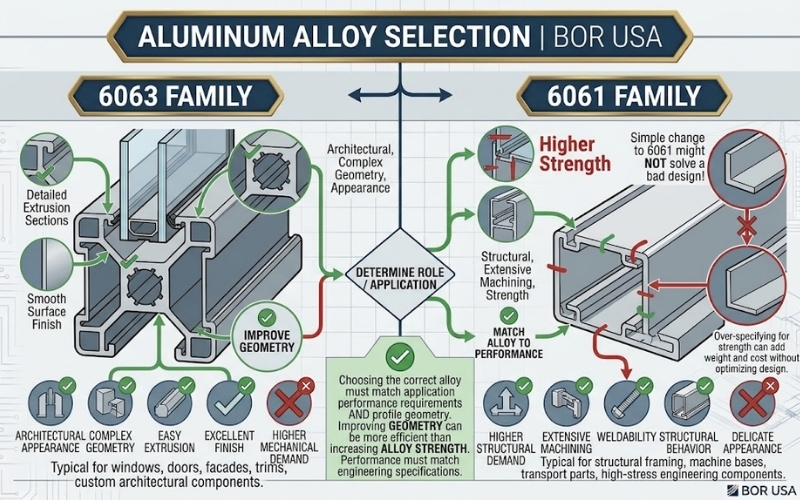
Alloy selection should follow the performance requirements of the finished component rather than simply choosing the most familiar aluminum grade.
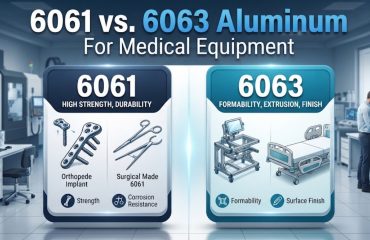
For architectural applications, 6063 is commonly considered because of its extrusion characteristics and surface finish performance. 6061 is often considered when higher mechanical performance and machining capability are important.
| Requirement | Typical Direction | Reason |
|---|---|---|
| Architectural appearance | 6063 family | Good extrusion and finishing characteristics. |
| Complex architectural geometry | 6063 family | Suitable for detailed extrusion sections. |
| Higher structural demand | 6061 family | Higher mechanical strength potential. |
| Extensive machining | 6061 family | Often preferred where machining performance is important. |
| Project-specific requirements | Specified alloy and temper | Performance must match the engineering specification. |
However, alloy selection should never be separated from profile geometry.
Changing from 6063 to 6061 does not automatically solve a poorly designed cross-section. In many cases, improving the geometry can produce a more efficient solution than simply increasing material strength.
4. Understand the Role of Temper

Alloy and temper should be specified together.
For example, 6061-T6 and 6063-T5 are not simply different names for the same material. The temper describes the metallurgical condition and affects mechanical performance.
For building components, the specification should therefore identify:
- Aluminum alloy
- Temper condition
- Required mechanical properties
- Surface finish
- Application environment
This becomes particularly important when an aluminum extrusion is used in a load-bearing or mechanically demanding assembly.
5. Profile Geometry Often Matters More Than Increasing Wall Thickness
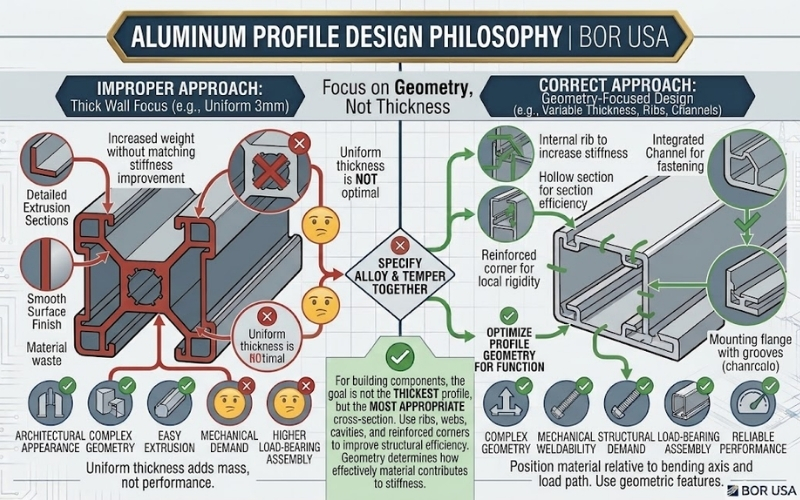
One of the most common mistakes in aluminum profile design is increasing wall thickness without first evaluating the cross-section.
Adding material can increase weight without delivering the desired improvement in stiffness.
A better approach is to examine where the material is positioned relative to the expected bending axis and load path.
Ribs, webs, channels, cavities and reinforced corners can sometimes improve structural efficiency without simply making every wall thicker.
| Geometry Feature | Potential Function |
|---|---|
| Internal rib | Increase stiffness without uniformly increasing wall thickness. |
| Hollow section | Improve section efficiency while controlling mass. |
| Channel | Provide fastening or component integration. |
| Reinforced corner | Improve local rigidity. |
| Mounting flange | Create a defined installation interface. |
| Integrated groove | Accommodate fasteners, seals or accessories. |
The objective is not to create the thickest profile. The objective is to create the most appropriate cross-section for the required function.
6. How Thick Should an Aluminum Profile Be?
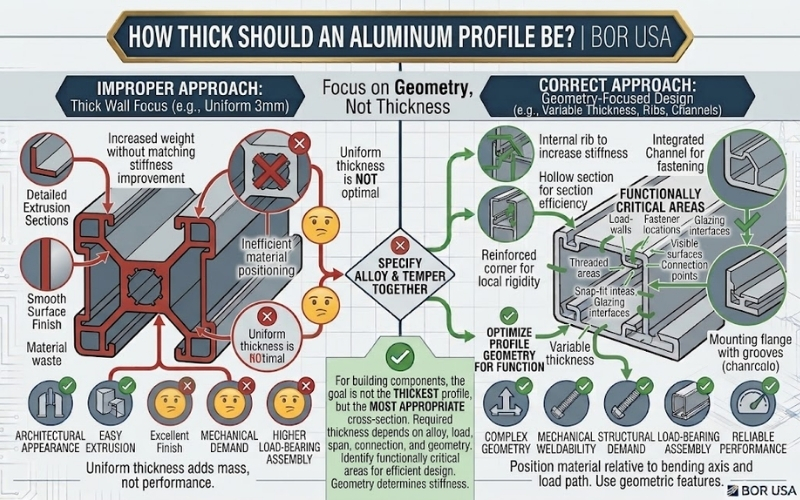
There is no universal wall thickness that is correct for every building application.
The required thickness depends on alloy, profile geometry, extrusion feasibility, load, span, local stress, connection method and dimensional requirements.
A decorative trim may require a very different wall thickness from a structural frame.
When specifying a custom profile, avoid assigning unnecessarily tight minimum wall thicknesses across the entire section.
Instead, identify the areas where thickness is functionally critical.
- Load-bearing walls
- Fastener locations
- Threaded areas
- Snap-fit interfaces
- Glazing interfaces
- Visible surfaces
- Connection points
This approach can improve extrusion manufacturability and help control material consumption.
7. Decide Between a Standard and Custom Aluminum Profile
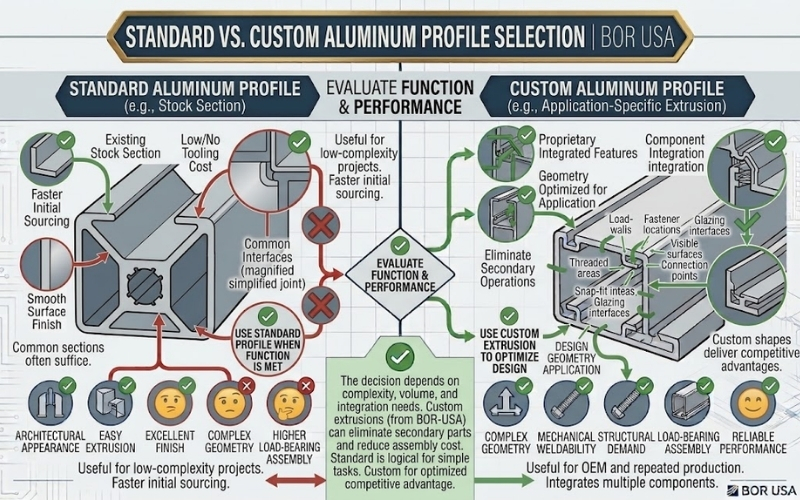
Another important decision is whether the project should use an existing standard profile or a custom extrusion.
| Standard Profile | Custom Profile |
|---|---|
| Lower or no new tooling requirement | Requires dedicated extrusion tooling |
| Faster initial sourcing | Requires engineering and tooling preparation |
| Good for common interfaces | Good for proprietary interfaces |
| Limited geometry selection | Geometry designed around the application |
| Useful for low-complexity projects | Useful for OEM and repeated production |
A standard profile is often the logical choice when an existing section already meets the functional requirements.
A custom extrusion becomes more attractive when the profile needs to integrate several components or eliminate multiple secondary parts.
BOR-USA’s aluminum profile portfolio includes standard and application-specific extrusion solutions. When an existing section cannot satisfy the interface or performance requirements, the custom extrusion process can be evaluated around the project geometry.
8. Consider the Building Interface Before Choosing the Profile
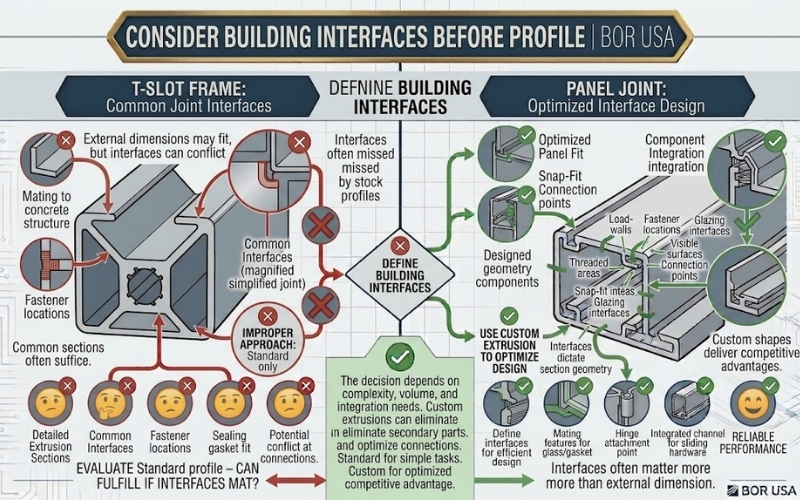
An aluminum extrusion rarely works alone.
It may connect to glass, wood, steel, concrete, panels, gaskets, fasteners, hinges, rollers or other aluminum components.
That means the profile must be designed around its interfaces.
For example, a window frame profile must accommodate the actual glazing and sealing system. A sliding profile must work with the relevant moving components. A kitchen base profile must fit the cabinet and floor interface.
Similarly, a frame cover profile should be evaluated according to the joint it must conceal or finish.
These interfaces are often more important than the overall external dimensions of the profile.
9. Match the Profile to the Architectural Application

Different building components create different aluminum extrusion requirements.
Window and Door Systems
Window profiles require careful consideration of glazing dimensions, seals, drainage, fasteners, thermal movement and installation tolerances.
For projects involving aluminum window systems, window frame profiles can be evaluated according to the required frame geometry and interface conditions.
Windowsills also have different functional requirements because they must manage edge conditions, drainage and architectural appearance. BOR-USA’s aluminum window sill profiles illustrate this application-specific approach.
Sliding Systems
Sliding applications require dimensional consistency because rollers, tracks and moving components depend on the profile interface.
A small dimensional mismatch can create excessive friction, poor alignment or premature component wear.
For these applications, aluminum sliding profiles should be evaluated based on the complete sliding assembly rather than the extrusion alone.
Floor and Transition Applications
Floor profiles may be used for transitions, edge finishing, surface protection or joining different flooring materials.
The profile must match the flooring thickness and installation method while providing sufficient durability for expected traffic.
For this reason, an aluminum floor profile should be selected according to the floor interface rather than only its visible width.
Baseboard and Wall Protection
Baseboard profiles can combine visual finishing with wall protection and cable or installation interfaces.
When selecting a baseboard aluminum profile, consider impact exposure, wall geometry, installation method and surface finish.
Hinge and Connection Applications
Hinge profiles require precise interfaces because movement and alignment are directly related to the extrusion geometry.
For doors, panels and other moving architectural components, an aluminum hinge profile should therefore be evaluated together with the hinge hardware and connection system.
10. Surface Finish Should Be Selected Before Production
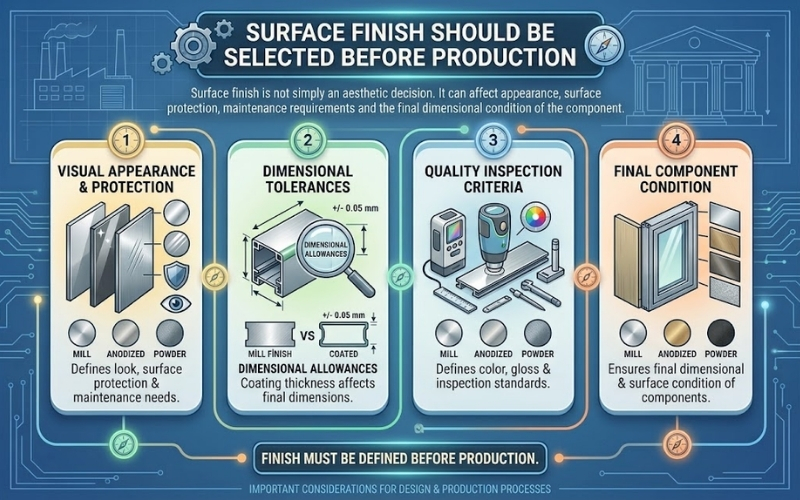
Surface finish is not simply an aesthetic decision.
It can affect appearance, surface protection, maintenance requirements and the final dimensional condition of the component.
| Finish | Typical Consideration | Application Direction |
|---|---|---|
| Mill finish | Basic extrusion surface | Hidden or subsequently processed components |
| Anodized | Architectural appearance and surface protection | Visible architectural applications |
| Powder coated | Color and protective coating | Architectural and commercial applications |
The finish should be defined before production because it may influence dimensional allowances, appearance requirements and quality inspection criteria.
11. Integrated Profiles Can Reduce Assembly Complexity

One of the strongest reasons to use aluminum extrusion is the ability to integrate multiple functions into one component.
A profile can incorporate mounting channels, covers, grooves, ribs, fastening interfaces and accessory locations into the extrusion itself.
This can reduce the number of separate components required during assembly.
For example, lighting applications may require the aluminum extrusion to accommodate LED components, diffusers and mounting interfaces. BOR-USA’s lighting profiles and hanger, shelf, LED and handle profiles demonstrate how extrusion geometry can be designed around integrated functions.
The important question is therefore not only “How much does the profile cost?”
The better question is:
How many components, operations and installation steps can the extrusion eliminate?
12. Tolerances: Do Not Specify Precision Everywhere
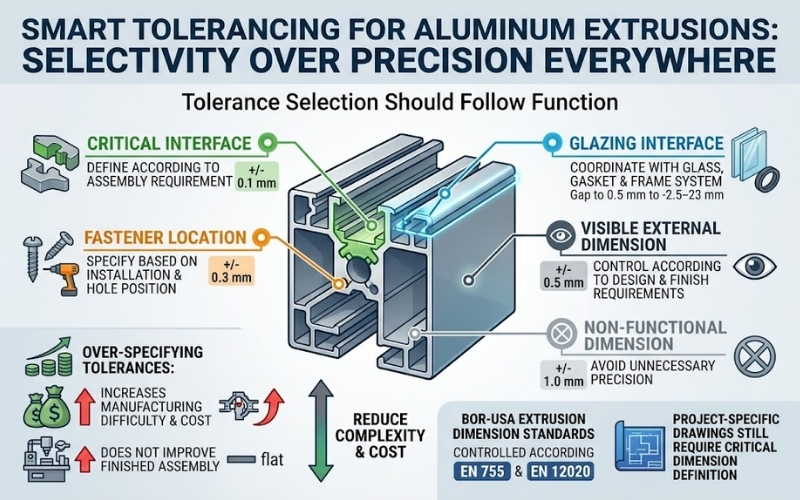
Tolerance selection should follow function.
Not every dimension in an aluminum extrusion needs the same precision.
Over-specifying tolerances can increase manufacturing difficulty and cost without improving the finished assembly.
| Dimension Type | Typical Approach |
|---|---|
| Critical interface | Define according to assembly requirement. |
| Fastener location | Specify based on installation and hole position. |
| Glazing interface | Coordinate with glass, gasket and frame system. |
| Visible external dimension | Control according to design and finish requirements. |
| Non-functional dimension | Avoid unnecessary precision. |
BOR-USA states that extrusion dimensions are controlled according to EN 755 and EN 12020 for its extrusion production. Project-specific drawings should still define the critical dimensions and applicable requirements.
13. Think About Manufacturing Before Finalizing the CAD Design
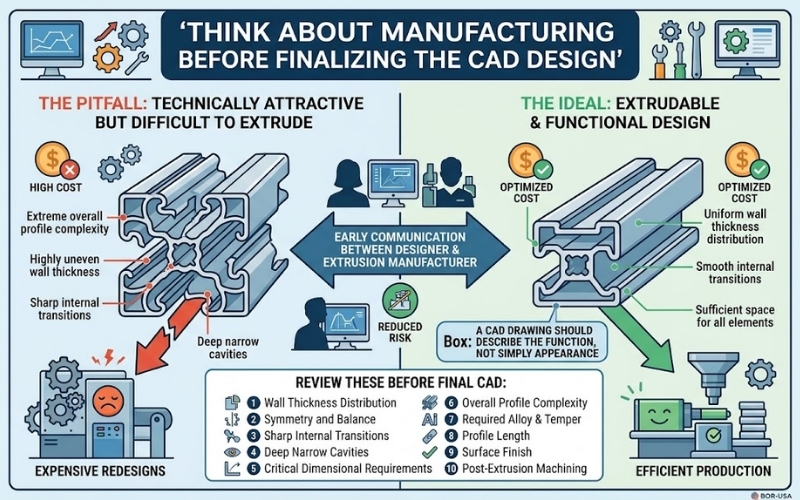
A profile can be technically attractive but difficult to extrude.
Good extrusion design considers manufacturing from the beginning.
Before finalizing a custom profile, review:
- Wall thickness distribution
- Symmetry and balance of the cross-section
- Sharp internal transitions
- Deep narrow cavities
- Critical dimensional requirements
- Overall profile complexity
- Required alloy and temper
- Profile length
- Surface finish
- Post-extrusion machining
This is where early communication between the designer and extrusion manufacturer can prevent expensive redesigns.
A CAD drawing should describe the function of the profile, not simply reproduce its desired appearance.
14. Calculate Total Cost, Not Only Aluminum Price
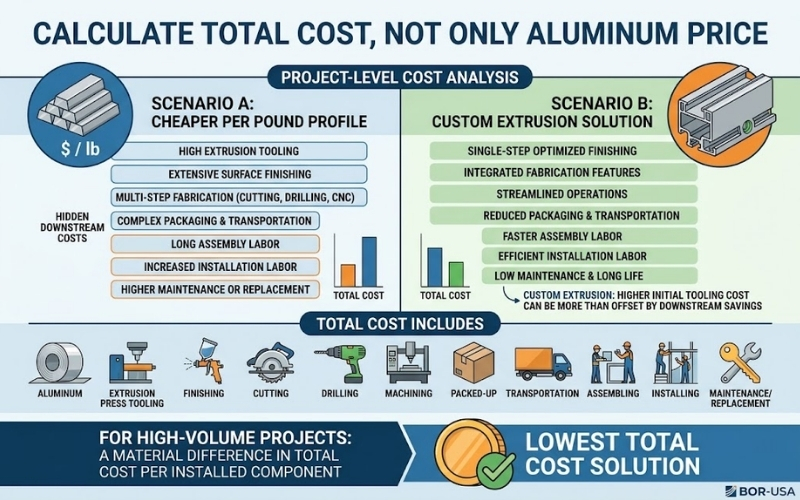
The cheapest profile per pound is not necessarily the lowest-cost solution for a building project.
Total cost can include:
- Aluminum material
- Extrusion tooling
- Surface finishing
- Cutting
- Drilling
- CNC machining
- Packaging
- Transportation
- Assembly labor
- Installation labor
- Replacement or maintenance costs
A custom extrusion can sometimes have a higher initial tooling cost but reduce several downstream operations.
For a high-volume project, this difference can materially affect the total cost per installed component.
15. When Does a Custom Aluminum Extrusion Make Sense?
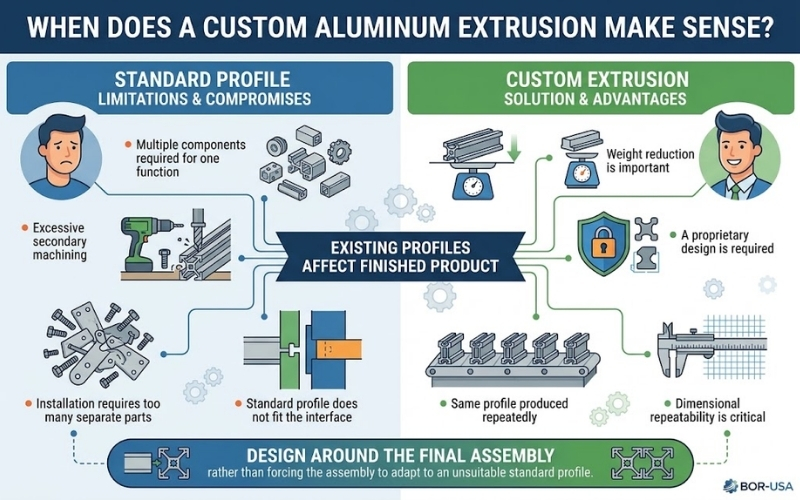
Custom extrusion should be considered when the existing profiles create compromises that affect the finished product.
Common indicators include:
- Multiple components are required to perform one function.
- Secondary machining is excessive.
- Installation requires too many separate parts.
- The available standard profile does not fit the interface.
- Weight reduction is important.
- A proprietary design is required.
- The same profile will be produced repeatedly.
- Dimensional repeatability is critical.
In these situations, the extrusion can be designed around the final assembly rather than forcing the assembly to adapt to an unsuitable standard profile.
The 7 Questions Engineers Should Answer Before Ordering
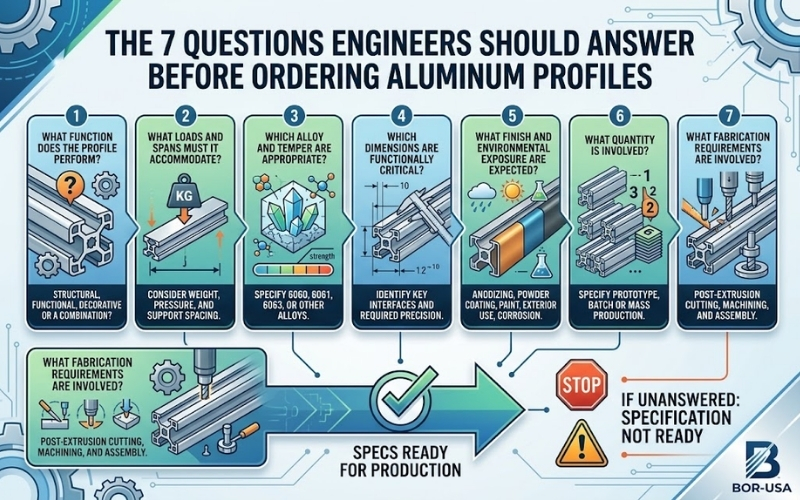
Before requesting an aluminum profile quotation, answer these seven questions.
- What function does the profile perform?
- Is it structural, functional, decorative or a combination?
- What loads and spans must it accommodate?
- Which alloy and temper are appropriate?
- Which dimensions are functionally critical?
- What finish and environmental exposure are expected?
- What quantity and fabrication requirements are involved?
If these questions cannot be answered, the profile specification is probably not ready for production.
Common Mistakes When Choosing Aluminum Profiles for Construction
| Mistake | Why It Creates Problems | Better Approach |
|---|---|---|
| Choosing by external dimensions only | Internal geometry may not support the required function. | Evaluate the complete cross-section. |
| Choosing alloy before defining the application | Material may not match the actual performance requirement. | Define function first. |
| Increasing wall thickness everywhere | Can increase weight and cost unnecessarily. | Optimize the geometry. |
| Ignoring mating components | Creates assembly and installation problems. | Design around interfaces. |
| Over-specifying tolerances | Can increase manufacturing cost. | Define functional tolerances. |
| Choosing finish at the end | Can create dimensional and appearance issues. | Specify finish during design. |
| Comparing only material price | Ignores fabrication and installation costs. | Evaluate total cost of ownership. |
What Should Be Included in an Aluminum Profile RFQ?
A technically useful RFQ allows the extrusion manufacturer to evaluate the project without guessing critical requirements.
| RFQ Information | Example |
|---|---|
| Application | Window frame, facade, floor transition, partition, furniture |
| Drawing | 2D section drawing or 3D CAD |
| Alloy | 6061, 6063 or specified project alloy |
| Temper | Required temper condition |
| Length | Standard extrusion length or cut length |
| Critical tolerances | Functional dimensions identified on drawing |
| Finish | Mill, anodized or powder coated |
| Quantity | Pieces, linear meters/feet or annual volume |
| Fabrication | Cutting, drilling, tapping, CNC or other operations |
| Packaging | Protection requirements for finished surfaces |
For U.S. projects, the applicable material and extrusion requirements should also be identified in the project documentation. ASTM B221 covers extruded aluminum and aluminum-alloy bars, rods, wire, profiles and tubes. ASTM B221 documentation can be used as a reference when defining applicable material requirements.
How BOR-USA Can Support an Aluminum Profile Project
Choosing the right profile is ultimately an engineering and manufacturing decision.
BOR-USA supports standard and custom aluminum extrusion applications across architectural, construction, lighting, furniture, automotive, solar and industrial sectors. Its extrusion capability includes 5-inch, 7-inch and 9-inch presses, with profile lengths up to 12 meters according to its extrusion documentation.
For construction projects, the most effective starting point is the application and the profile drawing.
From there, alloy, temper, geometry, wall thickness, tolerance, finish, fabrication and production volume can be evaluated as one system.
To review available profile solutions, visit the BOR-USA aluminum profiles category.
For projects requiring a dedicated cross-section, the BOR-USA aluminum extrusion manufacturing process can be evaluated around the required geometry and production requirements.
For technical or commercial project discussions, you can also contact BOR-USA with the drawing, application details and expected production volume.
Final Decision Checklist
Before approving an aluminum profile for a building project, verify the following:
- Application and function are clearly defined.
- Structural and non-structural requirements are separated.
- Load, span and installation conditions are understood.
- Alloy and temper are appropriate for the application.
- Cross-section geometry has been reviewed for stiffness and function.
- Wall thickness has been evaluated for both performance and manufacturability.
- Critical dimensions and tolerances are identified.
- Mating components and interfaces are included in the design.
- Surface finish is specified before production.
- Cutting and machining requirements are defined.
- Standard versus custom extrusion has been evaluated.
- Tooling and production volume have been considered.
- Total installed cost has been compared rather than material price alone.
BOR-USA Engineering Perspective: The best aluminum profile is not necessarily the strongest, lightest or cheapest section. It is the section whose geometry, material, tolerance and manufacturing process are correctly matched to the final building application.
Frequently Asked Questions About Choosing Aluminum Profiles for Building Projects
How do I choose the right aluminum profile for a building project?
Start with the profile’s function, then evaluate load, geometry, alloy, wall thickness, tolerance, finish, interfaces and production requirements. The profile should be selected as part of the complete assembly rather than as an isolated extrusion.
Is 6061 or 6063 better for architectural aluminum profiles?
Neither alloy is universally better. 6063 is commonly used for architectural applications where extrusion quality and surface finish are important, while 6061 is often considered when higher mechanical performance is required.
How thick should an aluminum extrusion be?
Required wall thickness depends on alloy, geometry, load, span, connection points and extrusion feasibility. There is no single wall thickness suitable for every architectural application.
Should I use a standard or custom aluminum profile?
Use a standard profile when an existing extrusion satisfies the functional and dimensional requirements. A custom extrusion becomes more attractive when the standard options require excessive modification, additional components or inefficient assembly.
Does aluminum profile geometry affect strength?
Yes. Cross-sectional geometry directly affects stiffness and structural efficiency. Ribs, webs, channels and other geometric features can improve performance without simply increasing wall thickness.
What information should I provide for an aluminum extrusion quotation?
Provide the application, profile drawing or CAD file, alloy, temper, critical tolerances, length, finish, quantity, fabrication requirements and expected production volume.
Can aluminum profiles be designed around existing building components?
Yes. Custom extrusion geometry can be developed around interfaces such as glass, gaskets, fasteners, panels, hinges, tracks and other components. This approach can improve assembly compatibility.
Why are aluminum extrusion tolerances important?
Tolerances determine whether the profile will fit correctly with mating components. Functional dimensions should receive appropriate control, while unnecessary precision should be avoided to prevent additional manufacturing cost.
Can a custom aluminum extrusion reduce assembly costs?
It can. An integrated extrusion may combine several functions into one component and reduce cutting, machining, fastening or installation operations. The economics depend on production volume and the complexity of the final assembly.
What standard applies to aluminum extrusion profiles?
The applicable standard depends on the material, product and project specification. ASTM B221 covers extruded aluminum and aluminum-alloy bars, rods, wire, profiles and tubes, while BOR-USA states that its extrusion dimensions are controlled according to EN 755 and EN 12020.

Bor Aluminum – Content Producer