Choosing the right aluminum profile for industrial machinery requires more than selecting a profile based on size or weight. Machine builders must evaluate load, stiffness, profile geometry, alloy, wall thickness, vibration, tolerances, connections, machining, surface finish and production volume together.
The right extrusion is the one that satisfies the machine’s functional requirements while remaining manufacturable, serviceable and commercially efficient. A profile that appears strong enough in a catalog can still create excessive deflection, alignment problems or unnecessary assembly costs when the actual load case is not considered.
This guide explains how to select aluminum profiles for machine frames, automation equipment, industrial structures and OEM machinery. It also explains when a standard extrusion is sufficient and when a custom aluminum extrusion can provide a better engineering solution.


How Do You Choose an Aluminum Profile for Industrial Machinery?
The correct aluminum profile should be selected according to the machine’s function, load case and required stiffness first. Alloy, cross-section, wall thickness, tolerances and manufacturing requirements should then be optimized around those requirements.
Selection Factor Key Question Why It Matters Application What function does the profile perform? Defines the basic engineering requirements. Load What static and dynamic loads act on the profile? Determines required strength and stiffness. Span How far is the profile unsupported? Strongly affects deflection. Geometry How is material distributed around the cross-section? Controls structural efficiency. Alloy & Temper What mechanical and manufacturing properties are required? Affects strength, extrusion and machining. Wall Thickness Where is additional material actually needed? Influences stiffness, weight and extrusion feasibility. Vibration Will the machine generate repeated dynamic forces? Can affect fatigue, alignment and service life. Tolerance Which dimensions must remain tightly controlled? Protects assembly and alignment. Fabrication Will the extrusion be cut or machined? Affects downstream production cost. Production Volume How many units or linear feet will be produced? Influences tooling economics and unit cost.
1. Start With the Machine Function
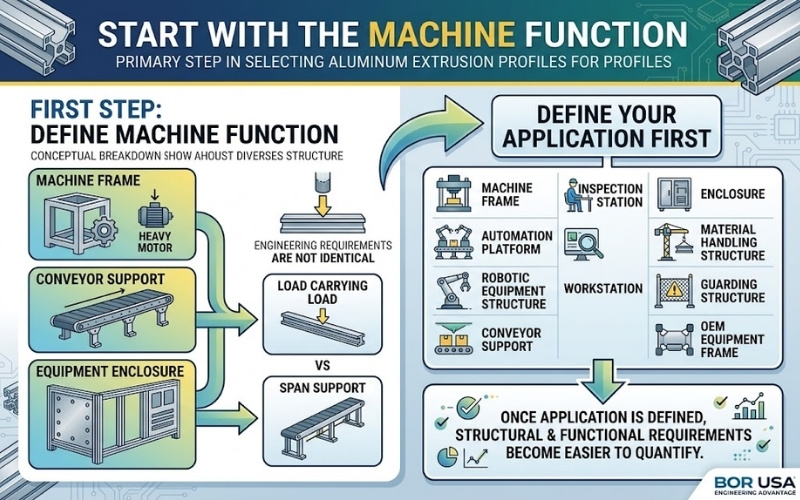
The first step is to define what the aluminum profile must actually do.
A machine frame, robotic cell structure, conveyor support and equipment enclosure may all use aluminum extrusion. Their engineering requirements are not identical.
For example, a machine frame may need to maintain dimensional stability under a concentrated equipment load. A conveyor structure may need continuous support over a longer span. An equipment enclosure may primarily require mounting surfaces and protective panels.
Therefore, profile selection should begin with the machine architecture rather than the available profile dimensions.
- Machine frame
- Automation platform
- Robotic equipment structure
- Conveyor support
- Inspection station
- Workstation
- Equipment enclosure
- Material handling structure
- Guarding structure
- OEM equipment frame
Once the application is defined, the structural and functional requirements become easier to quantify.
2. Determine Whether the Profile Is Structural, Functional or Both
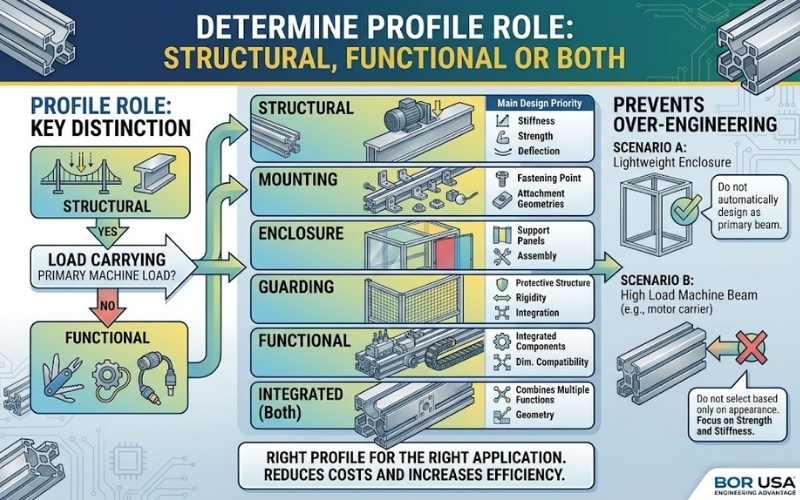
Not every extrusion used in industrial equipment carries the primary machine load.
Some profiles provide structural support. Others provide mounting interfaces, covers, cable routing, guarding or component integration.
| Profile Role | Typical Function | Main Design Priority |
|---|---|---|
| Structural | Support machine components and loads | Stiffness, strength and deflection |
| Mounting | Provide attachment points | Interface geometry and fastening |
| Enclosure | Support panels or covers | Geometry, appearance and assembly |
| Guarding | Create a protective structure | Rigidity, accessibility and integration |
| Functional | Integrate hardware or machine components | Dimensional compatibility |
| Integrated | Combine multiple functions | Geometry and manufacturability |
This distinction prevents over-engineering.
A profile that only supports a lightweight enclosure should not automatically be designed like a primary machine beam. Conversely, a profile carrying a motor, tooling or moving assembly should not be selected based only on appearance.
3. Define the Actual Load Case
Load is one of the most important variables in machine-frame profile selection.
However, simply stating that a machine weighs 500 kg is not enough information to select a profile.
The manufacturer or engineer should determine:
- Total equipment weight
- Weight distribution
- Point loads
- Distributed loads
- Unsupported span
- Support locations
- Load direction
- Dynamic forces
- Acceleration and deceleration
- External forces from connected equipment
A 500 kg machine supported at four points can produce a very different load case from the same mass concentrated near the center of a two-meter span.
This is why aluminum profile selection should be based on the load path, not simply the total machine weight.
4. Stiffness Can Be More Important Than Ultimate Strength
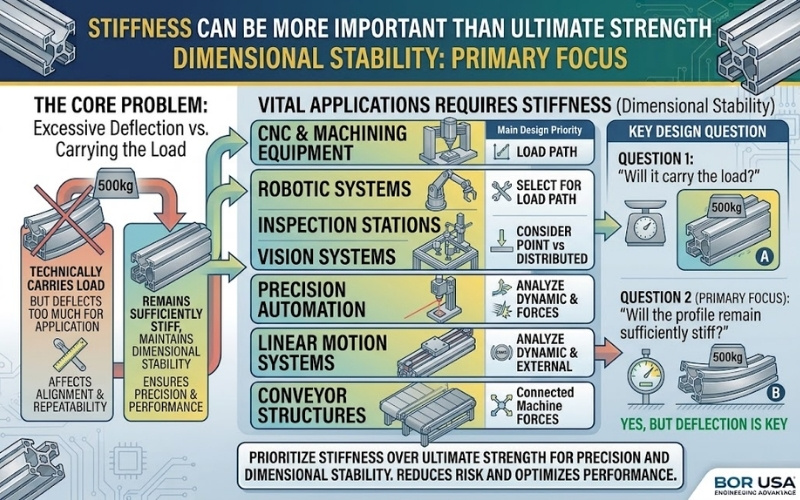
Industrial machinery often requires dimensional stability before the material approaches its ultimate strength.
A machine frame can technically support a load while still deflecting too much for the application.
This distinction is particularly important for:
- CNC and machining equipment
- Robotic systems
- Inspection stations
- Vision systems
- Precision automation
- Linear motion systems
- Conveyor structures
In these applications, excessive deflection can affect alignment, repeatability or component movement.
The engineering question is therefore not only:
“Will the aluminum profile carry the load?”
It is also:
“Will the profile remain sufficiently stiff under the operating load?”
5. Profile Geometry Directly Affects Machine Frame Stiffness
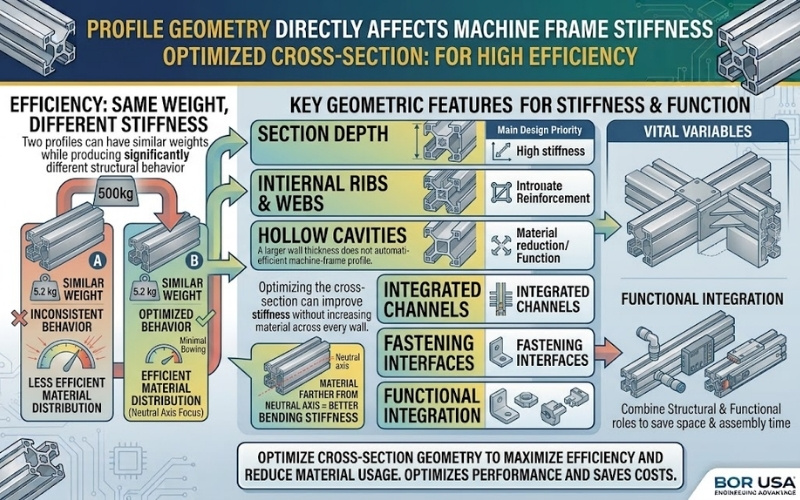
Cross-section geometry determines how efficiently aluminum contributes to structural stiffness.
Two profiles can have similar weights while producing significantly different structural behavior because their material is distributed differently around the neutral axis.
Important geometric features can include:
- Section depth
- Internal ribs
- Webs
- Hollow cavities
- Reinforced corners
- Mounting flanges
- Integrated channels
- Fastening interfaces
For bending applications, the location of material relative to the bending axis is particularly important.
This creates an important design principle:
A larger wall thickness does not automatically produce the most efficient machine-frame profile.
In many cases, optimizing the cross-section can improve stiffness without increasing material across every wall.
6. How Should Wall Thickness Be Selected?

There is no universal wall thickness for an industrial aluminum extrusion.
The required thickness depends on the alloy, cross-section, extrusion process, load, connection method, machining requirements and dimensional specifications.
Instead of making every wall thicker, identify where material is functionally required.
| Profile Area | Why Thickness May Matter |
|---|---|
| Load-bearing wall | Transfers structural forces. |
| Fastener location | Provides material for attachment. |
| Machined area | Must retain sufficient material after machining. |
| Connection point | Transfers forces into another component. |
| Mounting flange | Provides a stable installation surface. |
| Non-functional wall | May not require the same thickness as structural areas. |
Uniformly increasing wall thickness can add weight and material cost without providing proportional structural benefits.
7. Select the Alloy and Temper After Defining the Application
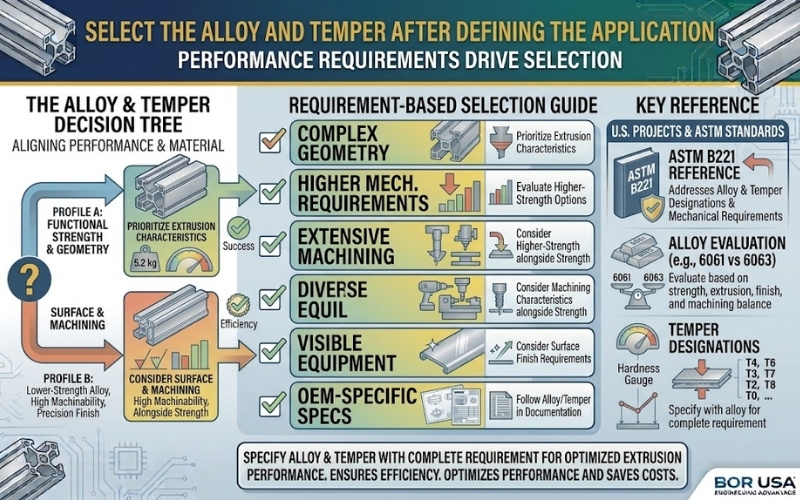
Aluminum alloy selection should follow the machine’s performance requirements.
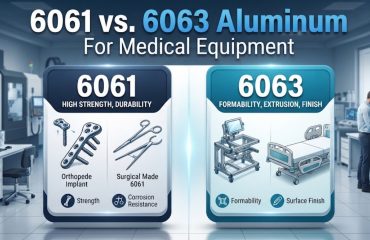
For industrial extrusions, engineers may evaluate alloys such as 6061 and 6063 depending on the required combination of strength, extrusion characteristics, surface finish and machining performance.
| Requirement | Selection Consideration |
|---|---|
| Complex extrusion geometry | Prioritize extrusion characteristics. |
| Higher mechanical requirements | Evaluate higher-strength alloy and temper options. |
| Extensive machining | Consider machining characteristics alongside strength. |
| Visible equipment | Consider surface finish requirements. |
| OEM-specific specification | Follow the required alloy and temper in the engineering documentation. |
Alloy and temper should therefore be specified as part of the complete extrusion requirement rather than chosen independently.
For U.S. projects, ASTM B221 is an important reference for extruded aluminum and aluminum-alloy profiles, bars, rods, wire and tubes. The standard addresses applicable alloy and temper designations and mechanical requirements.
8. Account for Dynamic Loads and Vibration
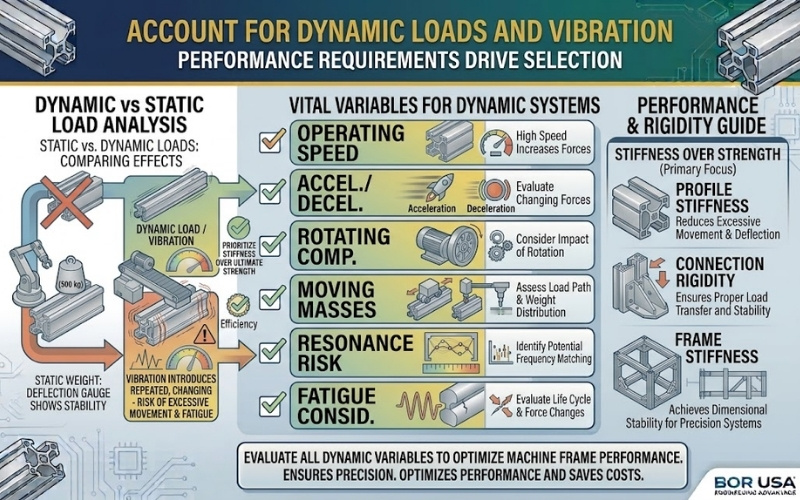
Industrial machinery rarely operates under purely static conditions.
Motors, pumps, linear actuators, robotic arms, conveyors and rotating equipment can introduce repeated or changing forces.
These loads can affect the profile differently from a simple static weight.
When vibration is expected, evaluate:
- Operating speed
- Acceleration
- Deceleration
- Rotating components
- Moving masses
- Connection rigidity
- Frame stiffness
- Potential resonance conditions
- Fatigue considerations
Increasing profile stiffness may be more useful than simply increasing material strength when the primary problem is excessive movement.
9. Consider the Connection System, Not Only the Extrusion
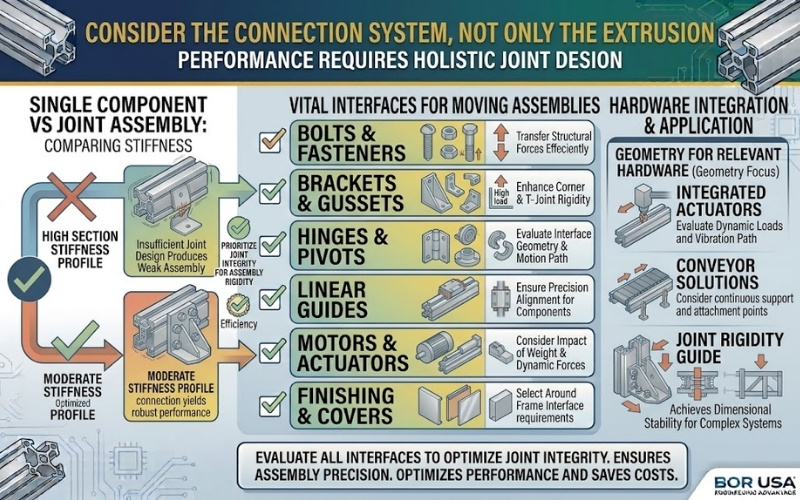
An aluminum profile does not operate independently.
Its performance depends on how it connects to other machine components.
Important interfaces may include:
- Bolts
- Brackets
- Hinges
- Panels
- Bearings
- Linear rails
- Motors
- Actuators
- Conveyor components
- Steel structures
A profile can have sufficient section stiffness while still producing a weak assembly if the connection points are poorly designed.
For moving industrial assemblies, the extrusion geometry should also be evaluated together with the relevant hardware. For example, an aluminum hinge profile has different interface requirements from a structural machine beam.
The same principle applies to cover and finishing components. A frame cover profile should be selected around the frame interface rather than treated as a structural replacement for the frame itself.
10. Tolerance Requirements Should Follow Machine Function
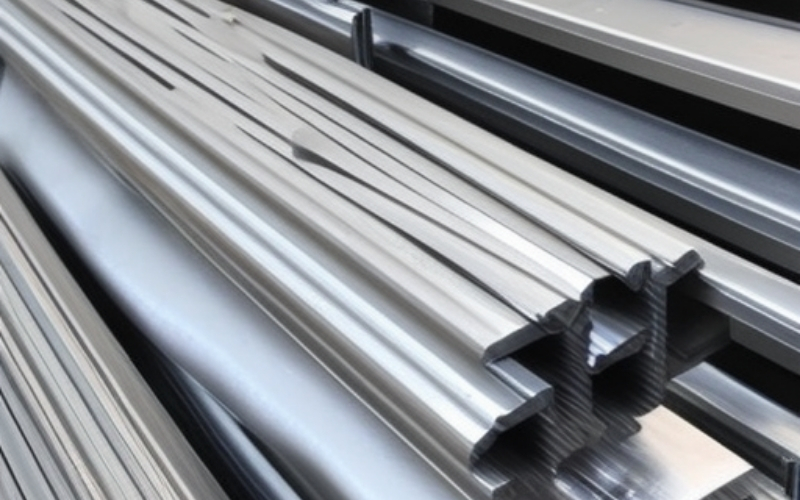
Industrial machinery can contain many dimensions, but not all of them require the same tolerance.
Over-specifying tolerances throughout the entire extrusion can increase manufacturing difficulty without improving machine performance.
| Dimension | Typical Importance |
|---|---|
| Critical mounting interface | High |
| Linear motion interface | High |
| Fastener location | Application-dependent |
| Panel support | Moderate |
| External decorative dimension | Application-dependent |
| Non-functional internal dimension | Usually lower |
The best practice is to identify the dimensions that control machine alignment, assembly and component fit.
Those dimensions can then receive the appropriate engineering requirements while non-critical features remain within practical extrusion tolerances.
11. Think About Machining Before Choosing the Profile
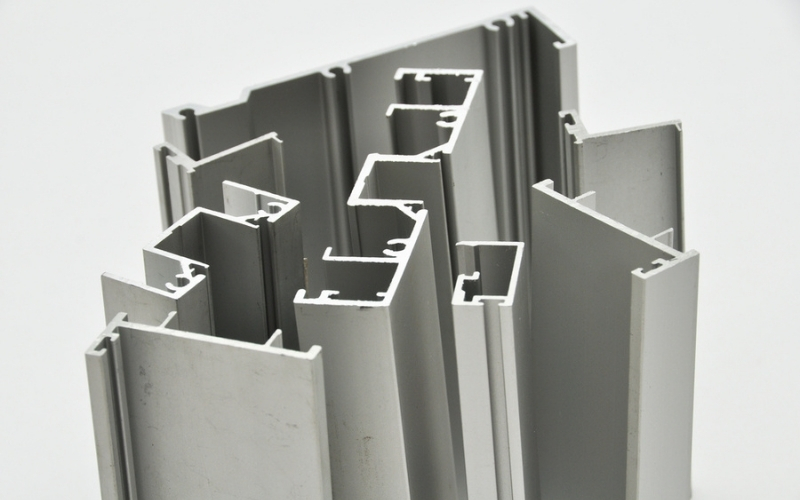
Many industrial aluminum profiles require secondary fabrication after extrusion.
Typical operations include:
- Cutting
- Drilling
- Tapping
- Milling
- CNC machining
- Slotting
- End preparation
- Hole patterns
The extrusion should be designed with these operations in mind.
A profile that looks efficient in cross-section may become expensive if every finished component requires extensive machining.
Conversely, an intelligently designed extrusion can incorporate fastening channels or interfaces that reduce secondary operations.
12. Integrated Geometry Can Reduce Assembly Work
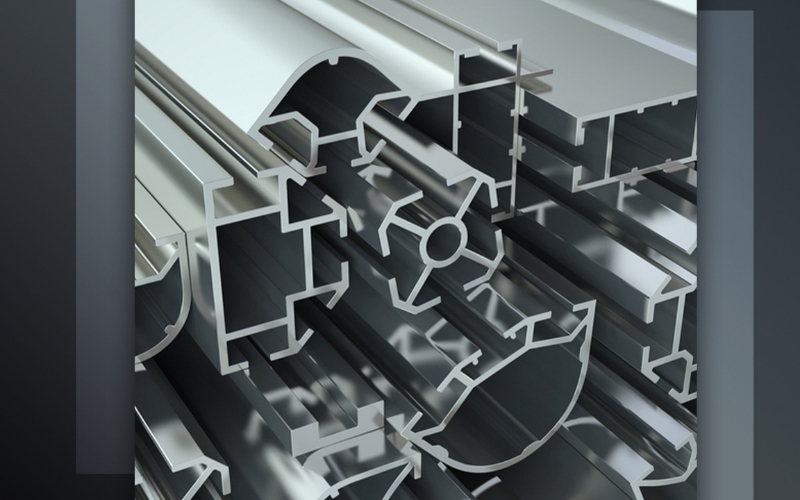
One of the main advantages of aluminum extrusion is the ability to integrate several functions into a single profile.
Instead of using separate plates, brackets and covers, the extrusion can sometimes incorporate:
- Mounting channels
- Fastening grooves
- Panel interfaces
- Cable routing areas
- Reinforcing ribs
- Accessory mounting points
- Protective covers
This can reduce component count and simplify assembly.
The economic benefit should therefore be evaluated at the assembly level rather than only at the extrusion price.
Engineering Question: How many separate parts and manufacturing operations can the extrusion eliminate?
13. Standard Aluminum Profiles vs. Custom Extrusions

Standard profiles are often the right solution when an existing extrusion already satisfies the machine’s requirements.
Custom extrusion becomes more attractive when the standard profile creates compromises in structure, assembly or production.
| Requirement | Standard Profile | Custom Extrusion |
|---|---|---|
| Prototype development | Often advantageous | May require additional preparation |
| Simple structural frame | Often sufficient | Usually unnecessary |
| Complex interface | May require brackets | Can integrate the interface |
| High-volume OEM production | Depends on application | Can improve unit economics |
| Weight optimization | Limited by available sections | Designed around the load case |
| Integrated functions | Limited | Strong advantage |
The decision should not be based solely on tooling cost.
Instead, compare the total cost of the complete machine assembly.
14. When Does a Custom Aluminum Extrusion Make Sense?
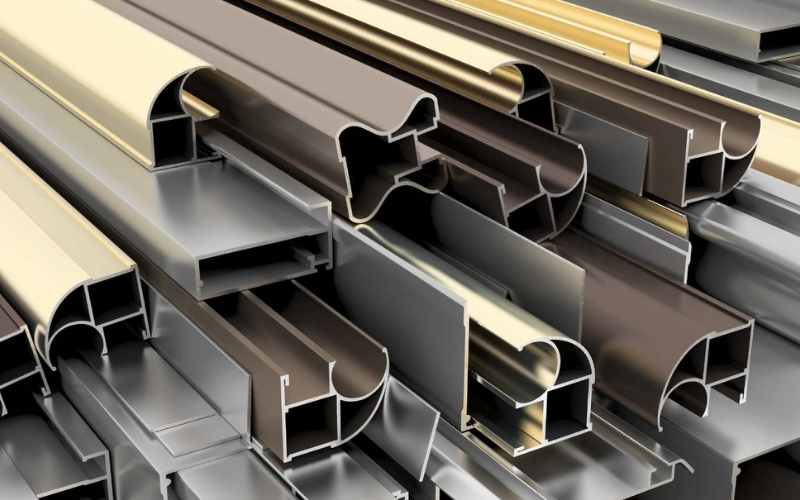
A custom extrusion should be considered when the standard options repeatedly force the machine design into inefficient compromises.
Typical indicators include:
- Excessive secondary machining
- Too many brackets or connectors
- Unnecessary profile weight
- Insufficient stiffness from standard sections
- Complex mounting interfaces
- High assembly labor
- Repeated production of the same machine
- Proprietary OEM requirements
- Need for integrated functions
Custom extrusion is particularly interesting for OEM equipment because the profile can be designed around the complete product rather than around a generic catalog section.
BOR-USA provides aluminum extrusion solutions that can be evaluated around application-specific geometry and manufacturing requirements. The aluminum extrusion manufacturing process is the appropriate starting point when a custom cross-section needs to be developed.
15. Calculate Total Cost Instead of Aluminum Price Alone
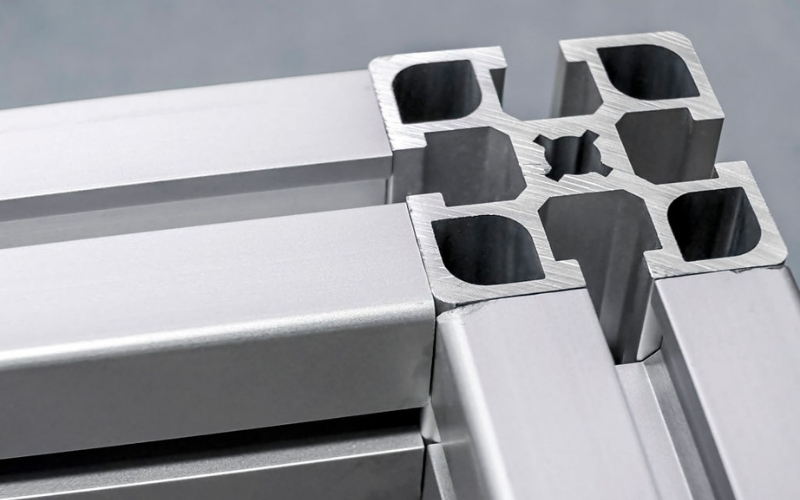
Material price is only one part of the cost of an industrial aluminum profile.
A more useful calculation includes:
| Cost Element | Potential Impact |
|---|---|
| Aluminum material | Determines basic material cost. |
| Extrusion tooling | Important for custom profiles. |
| Machining | Can become significant for complex parts. |
| Cutting | Depends on finished component requirements. |
| Finishing | Depends on appearance and environmental requirements. |
| Packaging | Important for finished or sensitive surfaces. |
| Assembly | Can be reduced through integrated extrusion geometry. |
| Maintenance | Can influence lifecycle economics. |
A custom extrusion with higher initial tooling cost can sometimes reduce the cost of every subsequent machine assembly.
This is why OEM buyers should compare total installed cost rather than only price per pound of aluminum.
16. Design the Profile Around the Machine’s Maintenance Requirements
Industrial equipment must also be serviceable after installation.
A profile design that makes assembly easy but prevents access to critical components can create maintenance problems later.
Before finalizing the extrusion, consider:
- Access to fasteners
- Component replacement
- Cable routing
- Panel removal
- Cleaning requirements
- Inspection points
- Adjustment mechanisms
- Future machine modifications
In some machines, a slightly more complex extrusion can simplify maintenance enough to justify its additional manufacturing cost.
17. Match the Profile to the Machine Environment
Industrial machinery can operate in very different environments.
The surrounding conditions should influence material and finish selection.
| Environment | Primary Consideration |
|---|---|
| Indoor factory | Mechanical performance and assembly. |
| Humid environment | Corrosion and surface protection. |
| Outdoor equipment | Weather exposure and finish durability. |
| Clean production area | Surface condition and cleanability. |
| High-contact area | Impact and surface durability. |
| High-temperature environment | Thermal behavior and material limits. |
Surface finish should therefore be selected together with the machine environment rather than added as a final cosmetic decision.
18. Do Not Ignore Thermal Expansion

Aluminum expands and contracts as temperature changes.
This becomes increasingly relevant when a machine uses long profiles, precision linear systems or components operating across significant temperature ranges.
Thermal movement can affect:
- Frame dimensions
- Alignment
- Linear motion components
- Fastener interfaces
- Machine guarding
- Sensor positions
- Long conveyor structures
The longer the extrusion and the greater the temperature change, the more important thermal movement becomes in the overall design.
For precision machinery, thermal expansion should be evaluated as part of the system rather than treated as an isolated material property.
19. Use Application-Specific Profiles Where They Add Real Value
Not every industrial component needs a custom structural extrusion.
Some components are better served by application-specific profiles that already provide the required interface.
For example, industrial equipment may include auxiliary components such as covers, sliding elements, floor interfaces, mounting systems or integrated lighting.
BOR-USA’s aluminum sliding profiles can be relevant where controlled sliding interfaces are required, while lighting profiles can be evaluated for integrated illumination within equipment or work areas.
Similarly, a baseboard profile or floor profile may be appropriate for auxiliary architectural or facility components surrounding industrial equipment, but they should not be confused with primary load-bearing machine-frame members.
This distinction keeps profile selection technically accurate and prevents the common mistake of treating every aluminum extrusion as interchangeable.
The 10 Questions to Answer Before Ordering an Aluminum Machine Profile
A profile specification is much stronger when the following questions have clear answers:
- What component will the extrusion form?
- What is the maximum static load?
- What dynamic loads will occur?
- What is the maximum unsupported span?
- What deflection is acceptable?
- Which direction will the primary load act?
- Which alloy and temper are required?
- Which dimensions are critical for assembly?
- What machining and finishing operations are required?
- What is the expected annual production volume?
If these questions cannot be answered, the aluminum profile specification is usually not mature enough for final production approval.
How BOR-USA Supports Industrial Aluminum Extrusion Projects
Industrial aluminum profile selection should connect engineering requirements with manufacturing capability.
BOR-USA provides aluminum extrusion solutions for industrial and OEM applications where profile geometry, material selection, fabrication and production requirements need to be considered together.
The company’s aluminum profile range can be evaluated when an existing extrusion may satisfy the application.
When a standard section does not provide the required combination of stiffness, interfaces, weight or manufacturability, the custom aluminum extrusion process can be considered around the machine’s actual requirements.
For project-specific requirements, drawings, alloy specifications, quantities and fabrication needs can be submitted through the BOR-USA contact page for further evaluation.
Additional application-specific components may also be considered where appropriate. For example, hanger, shelf, LED and handle profiles can support integrated equipment or workstation applications, while specialized profiles can be evaluated according to their actual interface requirements.
Frequently Asked Questions About Aluminum Profiles for Industrial Machinery
How do I choose the right aluminum profile for industrial machinery?
Start with the machine function, load case, unsupported span and required stiffness. Then evaluate profile geometry, alloy, wall thickness, tolerances, connections, machining and production volume.
What aluminum profile is best for a machine frame?
There is no single profile that is best for every machine frame. The appropriate section depends on load, span, deflection limits, connection design, vibration and the required machine geometry.
Is a heavier aluminum profile always stronger?
No. Profile geometry strongly influences stiffness and structural efficiency. Strategic material placement can provide better performance than simply increasing wall thickness throughout the section.
Is 6061 or 6063 aluminum better for industrial machinery?
Neither alloy is universally better. The appropriate choice depends on strength requirements, extrusion geometry, machining needs, surface finish and the specified temper.
How does profile geometry affect machine frame stiffness?
Cross-section geometry determines how material is distributed relative to the bending axis. Section depth, webs, ribs and hollow areas can significantly affect stiffness and deflection.
How thick should an aluminum machine-frame profile be?
Required wall thickness depends on the alloy, cross-section, load, connection points, machining requirements and extrusion feasibility. There is no universal thickness for every machine frame.
Should I use a standard or custom aluminum extrusion?
Use a standard profile when an existing section meets the machine’s requirements. A custom extrusion becomes more attractive when standard profiles require excessive machining, brackets, weight or assembly labor.
Can aluminum extrusion reduce industrial machine assembly costs?
Yes. A properly designed extrusion can integrate mounting channels, fastening interfaces and other functions. This can reduce separate components, machining and assembly operations.
What should an aluminum extrusion RFQ include?
An RFQ should include the application, CAD drawing, alloy, temper, dimensions, critical tolerances, length, finish, fabrication requirements, production volume and operating environment.
What standard covers extruded aluminum profiles?
ASTM B221 is a key U.S. specification covering extruded aluminum and aluminum-alloy bars, rods, wire, profiles and tubes, including applicable alloy and temper requirements.

Bor Aluminum – Content Producer