


Choosing between 6061 and 6063 aluminum for medical equipment depends on more than tensile strength. Medical equipment manufacturers should evaluate structural loads, profile geometry, extrusion complexity, surface finish, machinability, dimensional requirements, cleaning conditions and production volume before selecting the alloy.
For many medical equipment applications, 6063 is attractive when extrusion quality, complex profile geometry and surface appearance are important. 6061 becomes more compelling when higher mechanical performance and demanding machined or structural components are required. The correct choice depends on the complete design rather than the alloy designation alone.


6061 vs. 6063 Aluminum: Quick Comparison
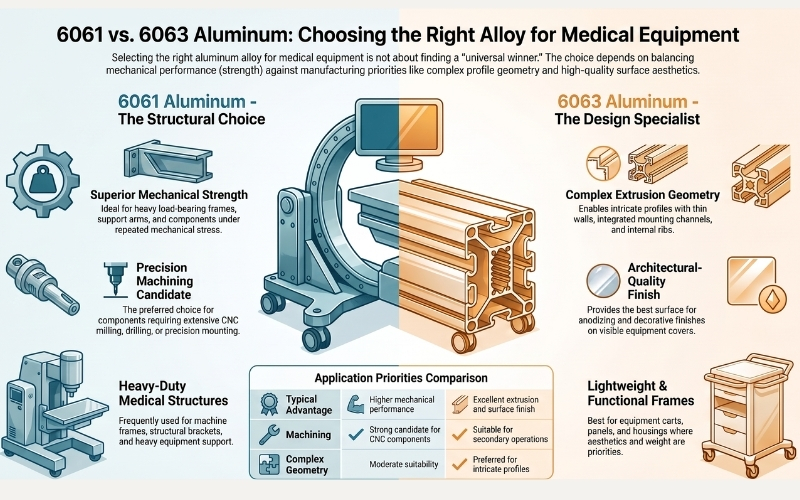
| Factor | 6061 Aluminum | 6063 Aluminum |
|---|---|---|
| Typical advantage | Higher mechanical performance in suitable tempers | Excellent extrusion characteristics and surface finish |
| Complex extrusion geometry | Suitable, but may be less advantageous for highly complex sections | Often preferred for intricate extrusion profiles |
| Machining | Strong candidate for machined components | Suitable for many secondary machining operations |
| Surface appearance | Good | Generally advantageous for architectural-quality finishes |
| Structural applications | Strong candidate where higher strength is required | Suitable when loads and stiffness requirements are compatible |
| Medical equipment frames | Suitable for higher-load structural applications | Suitable for lightweight frames and complex extrusions |
| Custom extrusion | Suitable depending on section complexity and requirements | Often attractive for complex profile designs |
| Best selection criterion | Mechanical performance and application requirements | Extrusion geometry, finish and application requirements |
Important: neither alloy is universally better for medical equipment. The required temper, profile geometry and actual load case can change the correct material choice.
1. What Is the Difference Between 6061 and 6063 Aluminum?

6061 and 6063 are both 6xxx-series aluminum alloys containing magnesium and silicon, but they are commonly selected for different engineering priorities.
The Aluminum Association describes the 6xxx series as heat-treatable, formable and weldable alloys with good corrosion resistance. It also identifies 6061 as a widely used alloy for structural applications. The Aluminum Association’s aluminum standards information provides additional background on the 6xxx series and alloy selection.
For extrusion projects, the distinction becomes particularly important because the alloy influences not only mechanical properties but also the way a profile can be manufactured.
That means a medical equipment designer should not ask only:
“Which alloy is stronger?”
The more useful question is:
“Which alloy provides the required mechanical performance while allowing the profile geometry, finish and manufacturing process that the equipment needs?”
2. Is 6061 Stronger Than 6063?
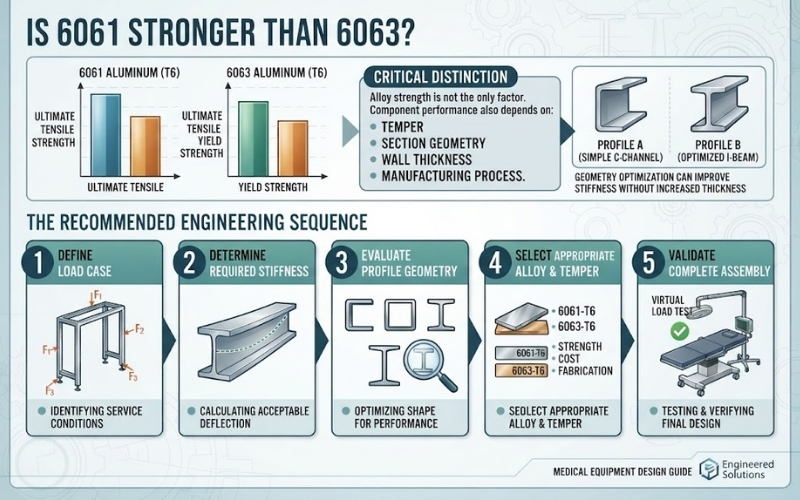
In commonly specified tempers, 6061 can provide higher mechanical strength than 6063. However, alloy designation alone does not determine the final performance of a medical equipment component.
The temper condition, section geometry, wall thickness and manufacturing process also influence the resulting component.
This distinction is critical for medical equipment because a profile with a higher nominal strength may not automatically provide a better frame.
For example, increasing section depth or optimizing the profile geometry can improve bending stiffness without simply increasing material thickness.
Therefore, the engineering sequence should be:
- Define the load case.
- Determine the required stiffness.
- Evaluate the profile geometry.
- Select the appropriate alloy and temper.
- Validate the complete assembly.
3. When Is 6061 a Better Choice for Medical Equipment?

6061 becomes particularly relevant when mechanical performance is a primary design constraint.
Examples may include:
- Load-bearing machine frames.
- Heavy medical equipment structures.
- Machined mounting components.
- Structural brackets.
- Equipment support arms.
- Components subjected to repeated mechanical loading.
- Assemblies requiring higher strength-to-weight performance.
If a medical equipment frame carries concentrated loads from motors, instruments, batteries, actuators or other heavy components, 6061 may deserve evaluation.
However, the decision should still be based on the complete structural calculation rather than alloy strength alone.
4. When Is 6063 a Better Choice for Medical Equipment?
6063 is particularly attractive when the extrusion itself is a major part of the product design.
This can be important when manufacturers require:
- Complex cross-sectional geometry.
- Thin or controlled wall sections.
- Integrated mounting channels.
- Long continuous profiles.
- Clean external surfaces.
- Anodized or decorative finishes.
- High-volume extrusion production.
For medical equipment, this can apply to equipment frames, covers, housings, support structures, panels and integrated functional profiles.
In other words, 6063 can be a strong candidate when extrusion manufacturability and surface quality are important design objectives.
5. Why Profile Geometry Can Matter More Than the Alloy Difference
One of the most common mistakes in aluminum profile selection is focusing on alloy strength before optimizing the section geometry.
The stiffness of a profile depends heavily on its cross-sectional geometry and second moment of area.
Consider two profiles with similar material weight. One may have a deeper section and strategically positioned ribs, while the other may have a compact solid geometry.
The deeper section can provide substantially different bending performance because more material is positioned away from the neutral axis.
For medical equipment frames, evaluate:
- Section depth.
- Profile orientation.
- Internal ribs.
- Hollow cavities.
- Corner reinforcement.
- Wall distribution.
- Mounting flanges.
- Connection locations.
This is why changing from 6063 to 6061 is not always the correct solution when a frame is too flexible.
Sometimes the better solution is a better profile geometry.
6. 6061 vs. 6063 for Medical Equipment Frames
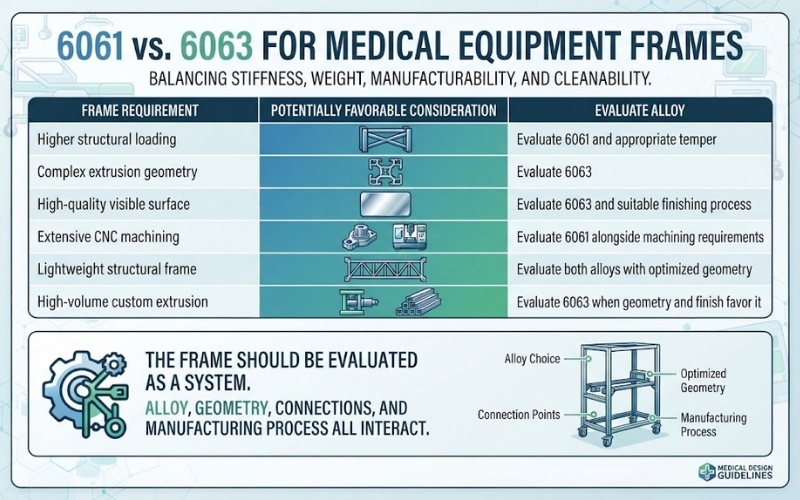
Medical equipment frames often need to balance stiffness, weight, manufacturability and cleanability.
| Frame requirement | Potentially favorable consideration |
|---|---|
| Higher structural loading | Evaluate 6061 and appropriate temper |
| Complex extrusion geometry | Evaluate 6063 |
| High-quality visible surface | Evaluate 6063 and suitable finishing process |
| Extensive CNC machining | Evaluate 6061 alongside machining requirements |
| Lightweight structural frame | Evaluate both alloys with optimized geometry |
| High-volume custom extrusion | Evaluate 6063 when geometry and finish favor it |
The important point is that the frame should be evaluated as a system. Alloy, geometry, connections and manufacturing process all interact.
7. What About Medical Equipment Carts?
Medical carts are a useful example because they combine structural and functional requirements.
A cart may need to carry monitors, instruments, batteries, drawers and accessories while remaining lightweight enough for frequent movement.
The frame may also experience repeated impacts, caster loads and dynamic forces when the cart moves over uneven surfaces.
In this application, the selection process should consider:
- Maximum equipment weight.
- Center of gravity.
- Caster configuration.
- Frame span.
- Handle loading.
- Vibration.
- Impact loading.
- Required surface finish.
- Cleaning requirements.
A higher-strength alloy may be useful for a heavily loaded structural component, while a 6063 extrusion may be advantageous for a complex frame or integrated housing.
The correct answer therefore depends on which component is being designed.
8. Surface Finish: An Important Medical Equipment Consideration

Surface finish is not only an aesthetic decision in medical equipment.
The surface can affect appearance, corrosion resistance, cleaning procedures and the long-term condition of exposed components.
6063 is frequently attractive when the visual quality of an extruded surface is important.
For equipment with visible aluminum frames, covers or trim components, the extrusion alloy should therefore be evaluated together with the intended anodizing, coating or other finishing process.
For example, BOR-USA’s frame cover profiles can illustrate how aluminum extrusion geometry can serve a functional and finishing role within an equipment assembly.
9. Does Medical Equipment Require a Specific Aluminum Alloy?
There is no universal rule that all medical equipment must use 6061 or 6063 aluminum.
The appropriate alloy depends on the component’s function and engineering requirements.
A medical equipment manufacturer may use different aluminum alloys or material specifications within the same product because different components have different requirements.
For example:
- A structural support may prioritize mechanical strength.
- A complex cover may prioritize extrusion geometry and appearance.
- A mounting component may require machining performance.
- A decorative trim may prioritize surface finish.
- A lightweight frame may prioritize stiffness-to-weight efficiency.
This component-specific approach is usually more efficient than selecting one alloy for every aluminum part.
10. How Does Machining Affect the 6061 vs. 6063 Decision?

Secondary machining can significantly change the economics and technical suitability of an extrusion.
Medical equipment components may require:
- Drilling.
- Tapping.
- Milling.
- Slotting.
- End machining.
- CNC contouring.
- Precision mounting surfaces.
6061 is often considered when a component requires demanding machining and mechanical performance.
However, this does not mean 6063 is unsuitable for machined medical equipment components. The actual geometry, temper, machining strategy and tolerance requirements must be evaluated.
The better question is therefore not “Which alloy machines better?” but “Which alloy and temper provide the required combination of machinability, mechanical performance and extrusion geometry?”
11. How Do Tolerances Affect Alloy Selection?
Extrusion tolerances should be defined according to the function of the component.
A medical equipment profile may contain both non-critical surfaces and precision interfaces.
For example, the following may have different tolerance requirements:
- External decorative surfaces.
- Panel interfaces.
- Fastener locations.
- Linear guide mounting surfaces.
- Hinge interfaces.
- Machined bearing seats.
ASTM B221 provides a specification framework for extruded aluminum and aluminum-alloy bars, rods, wires, profiles and tubes, including alloy and temper requirements. ASTM B221 can therefore be used as a reference point when defining an extrusion material specification.
Critical dimensions may still require secondary machining when the as-extruded tolerance is not sufficient for the application.
12. What About Cleaning and Surface Hygiene?

Medical equipment is frequently exposed to cleaning and disinfection procedures, so the profile design should support practical cleaning.
The alloy is only one part of this consideration.
Profile geometry can be equally important.
A well-designed medical equipment profile should minimize unnecessary areas that can collect dust, debris or cleaning residues.
Consider:
- Accessible surfaces.
- Joint geometry.
- Open cavities.
- Fastener locations.
- Sharp internal transitions.
- Surface finish.
- Panel interfaces.
For this reason, the material decision should be made together with the profile design rather than independently.
13. 6061 vs. 6063 for Custom Aluminum Extrusion
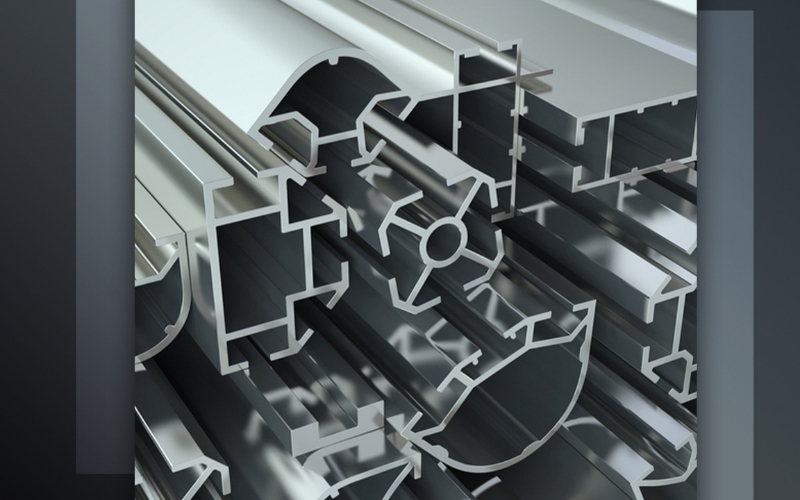

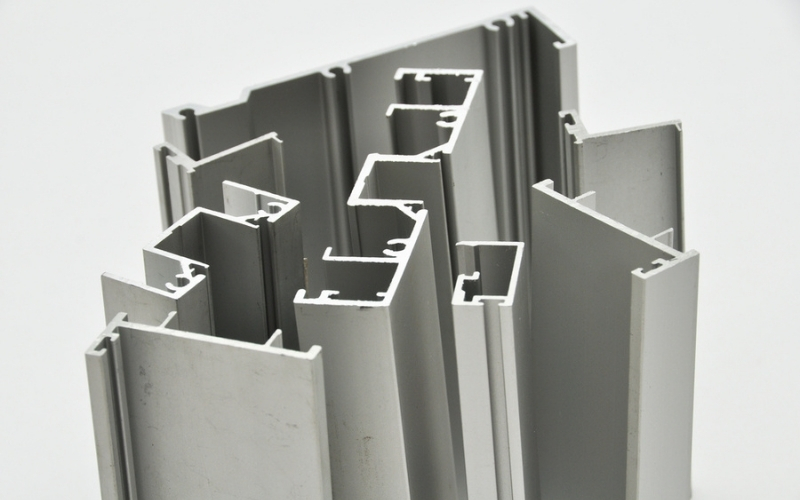
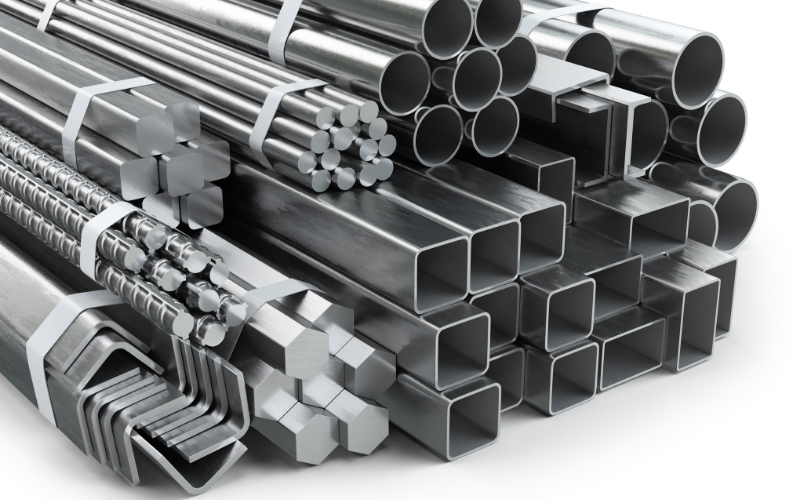
Custom extrusion can change the material selection because the profile geometry itself becomes part of the engineering solution.
A custom medical equipment profile can integrate:
- Mounting channels.
- Fastener locations.
- Panel retention features.
- Cable routing paths.
- Cover interfaces.
- Hinge interfaces.
- Lighting channels.
When these features are incorporated directly into the extrusion, secondary components and machining operations may be reduced.
BOR-USA provides aluminum extrusion solutions for projects where profile geometry, manufacturing requirements and application needs must be considered together.
14. Can Medical Equipment Use Different Aluminum Profiles for Different Functions?
Yes. In many products, using the same profile for every function is not the most efficient approach.
A medical equipment assembly may combine structural profiles with functional and finishing profiles.
For example, BOR-USA offers different profile geometries that can be relevant to specific non-structural functions:
- Aluminum hinge profiles for hinged interfaces.
- Sliding profiles for moving or adjustable components.
- Lighting profiles for integrated illumination.
- Hanger, shelf, LED and handle profiles for functional equipment components.
These profiles should not automatically be treated as primary structural members. Their value comes from matching the geometry to the specific function.
15. What About Architectural-Type Aluminum Profiles in Medical Equipment?
Some medical equipment incorporates architectural or interior-style aluminum components for finishing, protection or integration.
Examples include:
- Baseboard profiles.
- Floor profiles.
- Window frame profiles.
- Aluminum window sill profiles.
- Kitchen base profiles.
These examples demonstrate the breadth of aluminum extrusion geometry, but they should not be selected for medical equipment frames solely because their dimensions appear suitable.
The structural function, load path and required mechanical properties must always be validated first.
16. How Should You Choose Between 6061 and 6063?
A practical decision process can be simplified into five questions.
| Question | If the answer is… | Direction to investigate |
|---|---|---|
| Does the component carry significant structural loads? | Yes | Evaluate 6061 and suitable tempers |
| Does the profile require complex extrusion geometry? | Yes | Evaluate 6063 and extrusion feasibility |
| Is surface appearance a major requirement? | Yes | Evaluate 6063 and the finishing process |
| Does the component require substantial machining? | Yes | Compare alloy, temper and machining requirements |
| Is the profile produced in high volume? | Yes | Evaluate custom extrusion economics |
This is not a substitute for engineering validation. It is a screening method for identifying which material deserves closer evaluation.
17. Standard vs. Custom Medical Equipment Aluminum Profiles
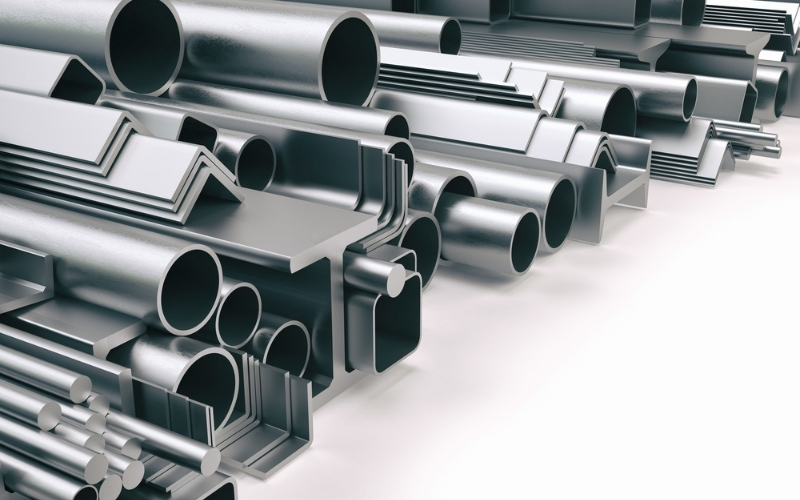
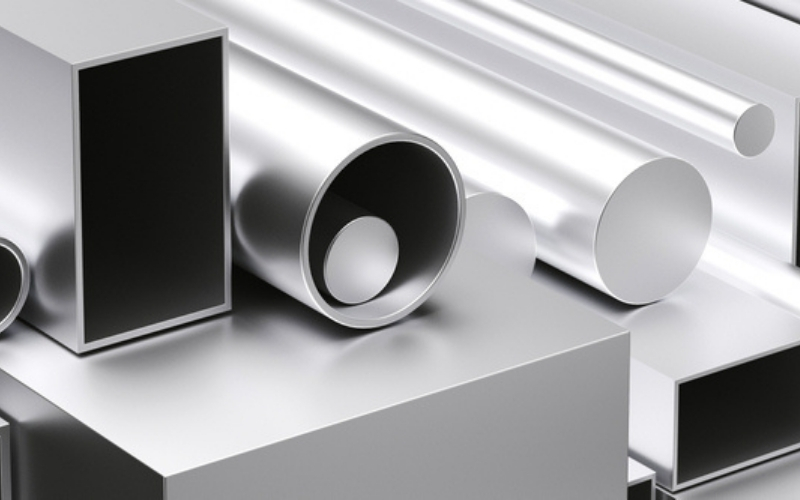
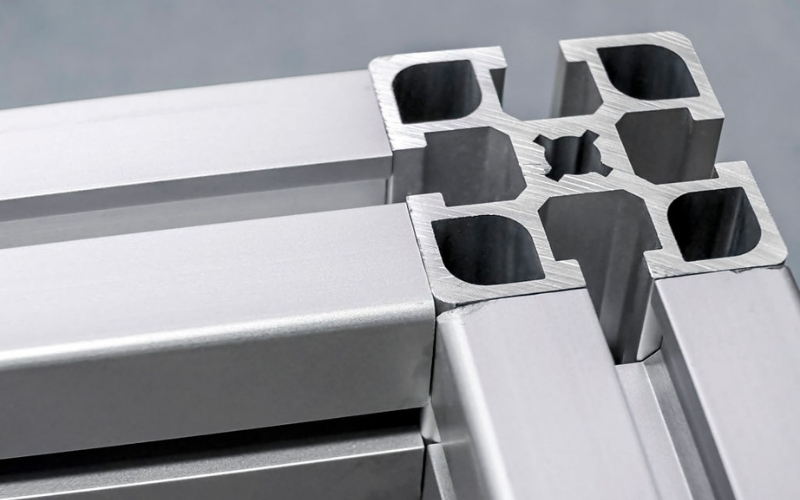
Before selecting an alloy, determine whether a standard profile can meet the application’s requirements.
| Requirement | Standard profile | Custom extrusion |
|---|---|---|
| Prototype development | Often advantageous | May add initial tooling cost |
| Complex integrated features | May require machining | Can integrate features into the section |
| High production volume | May require many secondary operations | Can become more efficient |
| Proprietary equipment design | Limited to available geometry | Designed around the equipment |
| Weight optimization | Limited by existing sections | Geometry can be optimized |
When standard profiles do not provide the required geometry, the aluminum profile range from BOR-USA can be evaluated alongside a custom extrusion approach.
18. How Does Production Volume Affect the Alloy Decision?
Material selection should also consider production volume.
For prototypes and small production runs, a readily available standard extrusion may minimize initial investment.
For larger production volumes, a custom profile can become more attractive because integrated geometry may reduce machining, brackets, connectors and assembly labor.
The relevant calculation is therefore not simply:
Cost of aluminum per kilogram
It should instead consider:
Material + tooling + machining + finishing + assembly + logistics + maintenance.
This total-cost approach is particularly important for OEM medical equipment manufacturers producing repeated product configurations.
19. A Practical 6061 vs. 6063 Selection Checklist
Before specifying the alloy, answer the following questions:
- What is the function of the component?
- What loads will it carry?
- What is the maximum acceptable deflection?
- Is the load static or dynamic?
- What is the unsupported span?
- Does the profile require complex geometry?
- How much machining is required?
- Which surface finish is required?
- Will the component be cleaned or disinfected frequently?
- Are there critical mounting interfaces?
- What tolerances are actually required?
- What production volume is expected?
- Would a custom extrusion reduce assembly or machining?
- What is the total cost of the finished component?
20. What Should Be Included in a Medical Aluminum Extrusion RFQ?
A complete RFQ helps the extrusion manufacturer evaluate the correct alloy, temper and profile design.
Include:
- CAD drawing or profile cross-section.
- Overall dimensions.
- Preferred alloy, if already defined.
- Required temper, if applicable.
- Critical tolerances.
- Cut lengths.
- Estimated annual volume.
- Surface finish.
- Machining requirements.
- Assembly interfaces.
- Application environment.
- Structural or loading requirements.
If the alloy has not yet been finalized, provide the application and performance requirements rather than forcing a material specification too early.
This allows the extrusion design to be evaluated as a complete engineering solution.
21. How BOR-USA Can Support Medical Equipment Aluminum Extrusion Projects

Choosing between 6061 and 6063 is only one part of developing a medical equipment aluminum profile.
The final solution may also require profile optimization, extrusion development, machining, finishing and production planning.
BOR-USA provides aluminum extrusion solutions for applications where the material, profile geometry and manufacturing process need to work together.
You can review the BOR-USA aluminum extrusion capabilities or contact the team through the contact page with your technical requirements.
Final Takeaway: 6061 or 6063?
Choose 6061 when mechanical performance is the dominant requirement; evaluate 6063 when extrusion geometry, surface quality and manufacturability are major priorities.
However, medical equipment design should never be reduced to an alloy-versus-alloy comparison.
The correct decision comes from evaluating alloy, temper, profile geometry, wall thickness, stiffness, loading, machining, surface finish, tolerances, cleaning requirements and production volume together.
For OEM medical equipment manufacturers, the most efficient solution may also be a custom aluminum extrusion designed around the equipment’s actual interfaces and manufacturing process.
For a project-specific evaluation, contact BOR-USA with your profile drawing, application requirements and expected production volume.
Frequently Asked Questions About 6061 vs. 6063 Aluminum for Medical Equipment
Is 6061 or 6063 better for medical equipment?
Neither alloy is universally better. 6061 is often considered when higher mechanical performance is required, while 6063 is often attractive for complex extrusion geometry and surface finish.
Is 6061 stronger than 6063 aluminum?
In commonly specified tempers, 6061 can provide higher mechanical strength than 6063. The final performance also depends on temper, geometry and component design.
Why is 6063 aluminum commonly used for extrusions?
6063 is widely used for extruded profiles because it can provide favorable extrusion characteristics and surface quality, particularly for complex or visible sections.
When should medical equipment manufacturers consider 6061 aluminum?
6061 should be evaluated when the component has demanding structural loads, higher mechanical requirements or extensive machining requirements.
When should medical equipment manufacturers consider 6063 aluminum?
6063 should be evaluated when complex extrusion geometry, surface appearance, integrated features and efficient profile production are important.
Can 6063 be used for medical equipment frames?
Yes. 6063 can be suitable for medical equipment frames when the selected profile geometry and temper provide the required strength and stiffness.
Does the alloy determine the stiffness of an aluminum medical equipment frame?
No. Stiffness depends strongly on the profile geometry, section properties, span, loading and connections in addition to the material properties.
Which aluminum alloy is better for custom medical equipment extrusion?
The answer depends on the required geometry, mechanical performance, surface finish, machining and production volume. 6063 can be attractive for complex extrusions, while 6061 may be preferred for higher-performance structural requirements.
Does 6061 or 6063 have better surface finish?
6063 is commonly favored when extrusion surface quality and finishing appearance are important, but the final result also depends on extrusion quality and the selected finishing process.
What information should be provided when requesting a 6061 or 6063 aluminum extrusion quote?
Provide the profile drawing, alloy and temper requirements, dimensions, tolerances, cut lengths, surface finish, machining requirements, application, loading conditions and expected production volume.

Bor Aluminum – Content Producer


