The right automotive aluminum extrusion supplier is the one that can reliably convert an OEM’s engineering requirements into a repeatable production process while controlling geometry, material, tolerances, quality, cost and delivery throughout the program lifecycle.
A supplier can offer an attractive extrusion price and still create significant downstream costs if the profile requires excessive machining, produces dimensional variation, has inconsistent surface quality, lacks technical documentation or cannot support production volumes when the program scales.
For automotive applications, supplier selection should therefore be treated as a manufacturing qualification decision, not simply a purchasing decision.


What Should an Automotive OEM Look for in an Aluminum Extrusion Supplier?
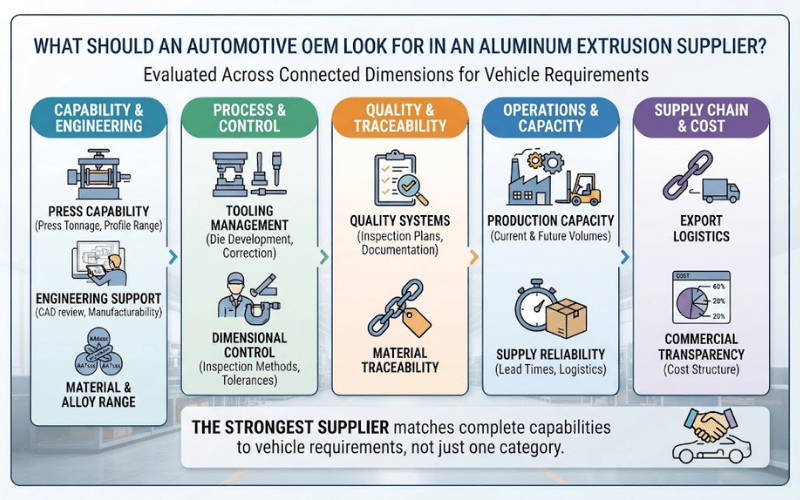
A qualified supplier should be evaluated across several connected dimensions rather than one specification.
| Evaluation Area | What the OEM Should Verify |
|---|---|
| Extrusion capability | Press capability, profile dimensions, alloys, wall thickness and geometry range |
| Engineering support | Ability to review drawings, CAD geometry, tolerances and manufacturability |
| Material capability | Alloy, temper and material traceability |
| Tooling | Die development, correction, maintenance and ownership terms |
| Dimensional control | Inspection methods, measurement equipment and tolerance management |
| Secondary operations | Cutting, machining, drilling, punching, bending, finishing and assembly capability |
| Quality | Inspection plans, documentation, corrective-action process and traceability |
| Production capacity | Ability to support both current and future annual volumes |
| Supply reliability | Lead times, production planning, packaging and export logistics |
| Commercial transparency | Clear tooling, material, processing and logistics cost structure |
The strongest supplier is not necessarily the one that scores highest in one category. The objective is to find a manufacturer whose complete capability matches the requirements of the vehicle program.
Why Supplier Selection Is Different for Automotive Aluminum Extrusions
Automotive programs create requirements that are more demanding than simply obtaining an aluminum profile with the correct dimensions.
A component may need to remain consistent across thousands or millions of production parts while maintaining defined dimensional characteristics, material properties, surface requirements and downstream machining interfaces.
That makes supplier capability important at three different stages:
- Engineering: Can the supplier manufacture the required geometry?
- Production: Can the supplier reproduce that geometry consistently?
- Program support: Can the supplier maintain quality, capacity and delivery over the program lifecycle?
A supplier that performs well during prototype production but cannot support serial production is not a complete solution for an OEM program.
1. Evaluate the Supplier’s Aluminum Extrusion Capability
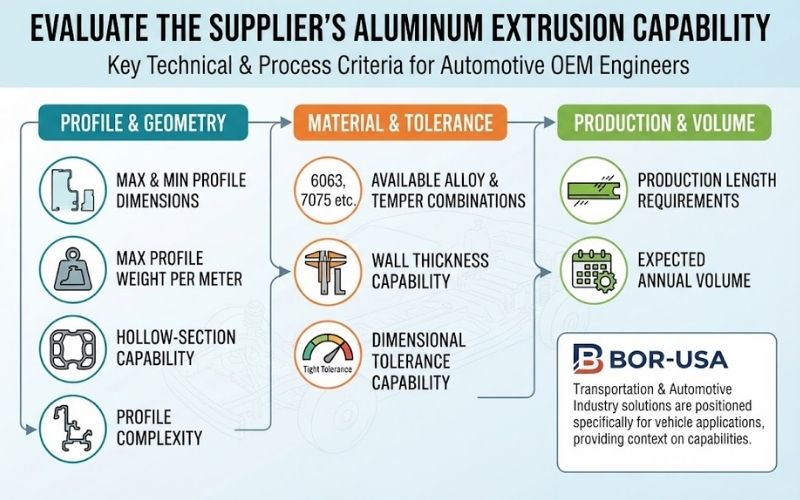
The first technical question should be whether the supplier’s extrusion equipment and process capabilities match the profile being developed.
OEM engineers should evaluate:
- Maximum and minimum profile dimensions
- Maximum profile weight per meter
- Available alloy and temper combinations
- Wall thickness capability
- Hollow-section capability
- Profile complexity
- Dimensional tolerance capability
- Production length requirements
- Expected annual volume
These parameters should be evaluated against the actual drawing rather than relying on a general statement such as “we manufacture aluminum profiles.”
The BOR-USA Transportation & Automotive Industry aluminum extrusion solutions are specifically positioned around transportation and automotive applications, while the broader aluminum profiles portfolio provides additional context on available profile types and extrusion capabilities.
2. Ask Whether the Supplier Can Participate in Profile Design
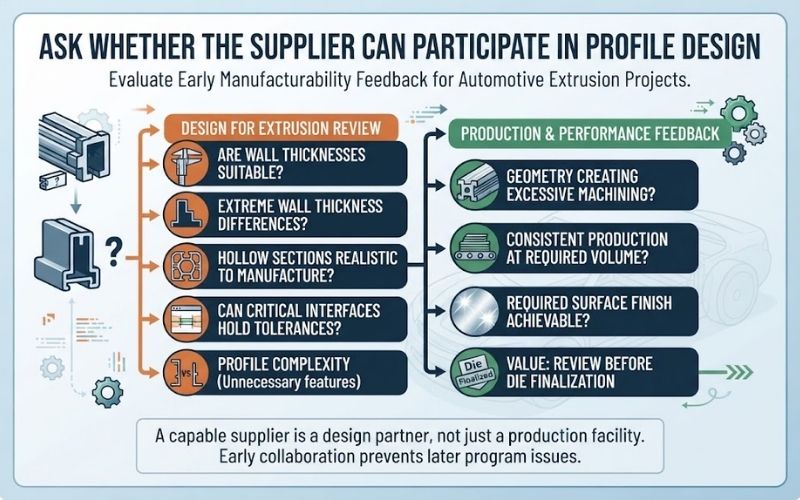
For custom automotive extrusion projects, the supplier should not be treated only as a production facility.
Manufacturability feedback during the design stage can prevent problems later in the program.
A technically capable extrusion supplier should be able to review questions such as:
- Are the wall thicknesses suitable for extrusion?
- Are there extreme differences in wall thickness?
- Are hollow sections realistic to manufacture?
- Can critical interfaces hold the specified tolerance?
- Can the profile be extruded without unnecessary complexity?
- Will the geometry create excessive machining requirements?
- Can the profile be produced consistently at the required volume?
- Can the required surface finish be achieved?
This type of Design for Extrusion review is especially valuable before the extrusion die is finalized.
3. Evaluate Alloy and Temper Knowledge

Automotive extrusion suppliers should be able to explain why a particular alloy and temper is appropriate for the application rather than simply accepting whatever material designation appears on a drawing.
Depending on the component, the material decision may involve trade-offs between:
- Strength
- Extrudability
- Corrosion resistance
- Machinability
- Surface appearance
- Weldability
- Heat treatment
- Cost
ASTM B221, for example, covers aluminum and aluminum-alloy extruded bars, rods, wire, profiles and tubes and specifies applicable alloy and temper designations and mechanical-property requirements. See ASTM B221 for the standard specification for aluminum and aluminum-alloy extruded profiles.
The important point for OEM procurement teams is that material selection should be connected to the component’s engineering function and manufacturing route.
4. Check Whether the Supplier Controls Extrusion Tooling

Tooling is one of the most important parts of a custom extrusion program.
The OEM should clarify:
- Who designs the extrusion die?
- Who owns the die?
- How are die corrections handled?
- Who approves die modifications?
- How is tool maintenance managed?
- What happens when the die reaches its service limit?
- How are replacement dies handled?
- How is the tooling cost quoted?
Tooling should not be considered a one-time purchasing item. It is part of the long-term manufacturing infrastructure behind the profile.
Supplier-selection rule: If the supplier cannot clearly explain how the extrusion die will be developed, corrected, maintained and reproduced, the OEM does not yet have sufficient manufacturing visibility.
5. Examine Dimensional and Tolerance Control
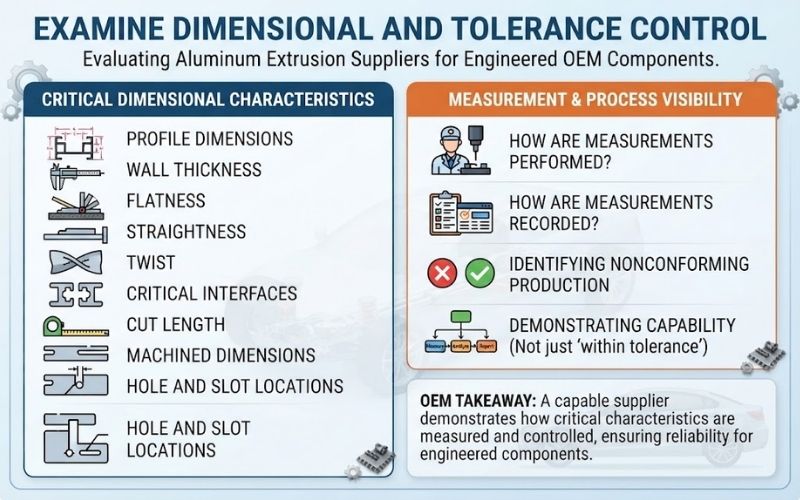
Dimensional capability is one of the most important differences between a general aluminum supplier and a supplier suitable for engineered OEM components.
The evaluation should cover:
- Profile dimensions
- Wall thickness
- Flatness
- Straightness
- Twist
- Critical interfaces
- Cut length
- Machined dimensions
- Hole and slot locations
OEMs should also ask how measurements are performed and recorded.
For critical components, it is not enough to receive a statement that the profile is “within tolerance.” The supplier should be able to demonstrate how the relevant characteristic is measured and how nonconforming production is identified.
6. Look Beyond the Extrusion Press

Many automotive components require significant processing after extrusion.
A supplier may therefore need to support or coordinate:
- Precision cutting
- CNC machining
- Drilling
- Punching
- Deburring
- Bending
- Welding
- Anodizing
- Powder coating
- Assembly
This is important because the cheapest extrusion stage does not necessarily produce the lowest finished-component cost.
If an inexpensive extrusion requires substantially more downstream machining than a slightly more optimized profile, the initial material price can become misleading.
The supplier evaluation should therefore consider the complete manufacturing route.
7. Ask How the Supplier Handles Custom Profile Development
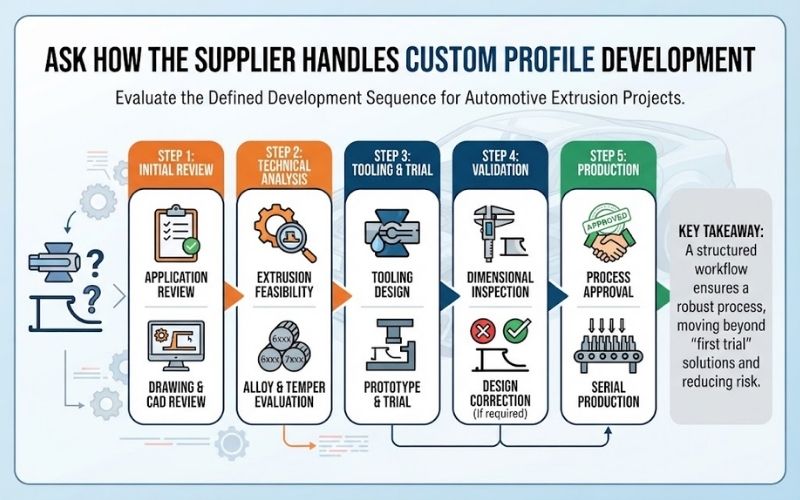
A custom extrusion program should have a defined development sequence.
A strong process typically moves through:
- Application review
- Technical drawing or CAD review
- Extrusion feasibility analysis
- Alloy and temper evaluation
- Tooling design
- Prototype or trial extrusion
- Dimensional inspection
- Design correction if required
- Process approval
- Serial production
- Ongoing quality monitoring
This workflow reduces the risk of treating the first extrusion trial as the final production solution.
8. Evaluate the Supplier’s Quality Documentation

Automotive OEM procurement teams should determine what documentation accompanies production batches and how material and process information can be traced.
Depending on the project, documentation may include:
- Material certificates
- Alloy and temper information
- Dimensional inspection reports
- Surface-finish specifications
- Process records
- Nonconformance reports
- Corrective-action documentation
- Batch or lot traceability
The exact documentation should be defined by the project requirements. The key principle is that the supplier should have a controlled process for proving that production conforms to the agreed specification.
9. Do Not Ignore Production Capacity
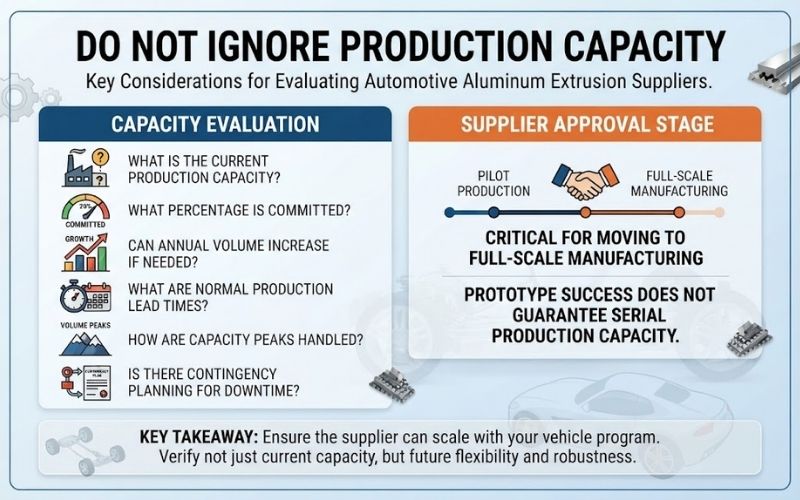
A supplier may successfully produce the required profile at prototype quantities but still lack sufficient capacity for serial production.
Before approving a supplier, ask:
- What is the current production capacity?
- What percentage of capacity is already committed?
- Can annual volume increase if the vehicle program expands?
- What are normal production lead times?
- How are capacity peaks handled?
- Is there contingency planning for equipment downtime?
This becomes particularly important when a vehicle platform moves from pilot production into full-scale manufacturing.
10. Evaluate Lead Time and Supply-Chain Reliability
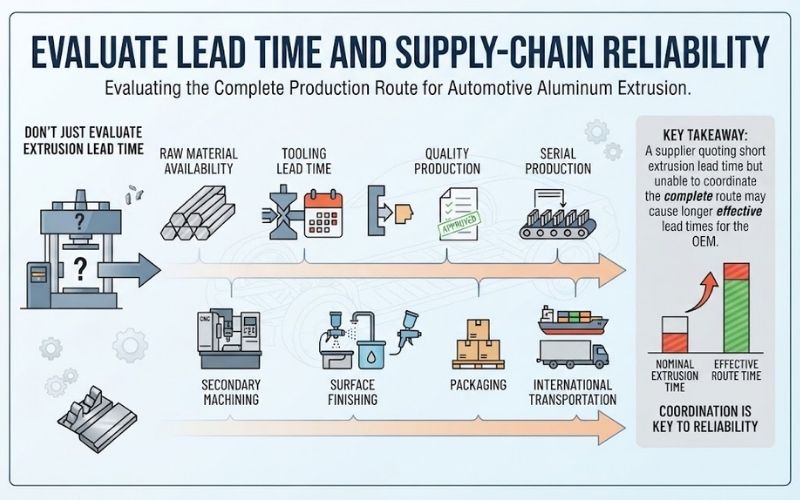
Automotive procurement should evaluate more than the nominal extrusion lead time.
The complete supply chain may include:
- Raw material availability
- Tooling lead time
- Trial production
- Quality approval
- Serial production
- Secondary machining
- Surface finishing
- Packaging
- International transportation
A supplier that quotes a short extrusion lead time but cannot coordinate the complete production route may create longer effective lead times for the OEM.
11. Compare Suppliers Using Total Cost, Not Kilogram Price

Price per kilogram is useful, but it is not sufficient for supplier selection.
A more realistic comparison should include:
| Cost Category | What to Compare |
|---|---|
| Material | Alloy, temper and profile weight per meter |
| Tooling | Die cost, corrections and replacement requirements |
| Extrusion | Production cost and minimum order requirements |
| Machining | CNC, drilling, punching and other secondary operations |
| Finishing | Anodizing, powder coating or other treatments |
| Quality | Inspection and documentation requirements |
| Packaging | Protection required for transport and handling |
| Logistics | Freight, export and delivery costs |
| Scrap | Material loss and rejected components |
| Assembly | Potential savings from integrated profile geometry |
The supplier with the lowest extrusion price may therefore not provide the lowest total landed cost.
12. Evaluate the Supplier’s Ability to Support Design Changes

Automotive programs rarely remain completely static from the first prototype to serial production.
Profile geometry, mounting features, tolerances, alloy, finish or machining requirements may change during development.
The supplier should therefore have a controlled engineering-change process.
Ask how the supplier manages:
- Drawing revisions
- CAD revisions
- Die modifications
- Material changes
- Process changes
- Inspection-plan updates
- Production approval after engineering changes
Change control becomes especially important when the same extrusion is supplied to multiple production locations or vehicle variants.
13. Assess Export and International Supply Capability

For an OEM sourcing aluminum extrusions internationally, manufacturing capability is only one part of supplier qualification.
The supplier should also demonstrate an understanding of:
- International shipping
- Export documentation
- Packaging for long-distance transportation
- Commercial documentation
- Delivery planning
- Communication across time zones
- Production scheduling
- International customer requirements
This can become a decisive factor when comparing an overseas extrusion manufacturer with a local supplier.
What Should an Automotive Aluminum Extrusion Supplier RFQ Include?
A supplier can only provide a meaningful quotation when the RFQ contains enough technical and commercial information.
An automotive extrusion RFQ should ideally include:
- 2D technical drawing
- 3D CAD model
- Profile dimensions
- Alloy and temper
- Dimensional tolerances
- Critical-to-function dimensions
- Required extrusion length
- Cut-length tolerance
- Annual volume
- Expected program duration
- Surface finish
- Machining requirements
- Inspection requirements
- Packaging requirements
- Delivery destination
- Prototype requirements
The more complete the RFQ, the more useful the supplier comparison becomes.
Standard Profile or Custom Extrusion for Aluminum Automotive Extrusion Profile?
Before qualifying a custom automotive parts extrusion supplier, OEM engineers should also determine whether a standard profile could meet the application.
BOR-USA’s standard aluminum profile range provides a starting point for applications where a predefined section may be sufficient.
Custom extrusion becomes more relevant when the application requires:
- Non-standard geometry
- Integrated mounting features
- Optimized wall thickness
- Special channels
- Reduced machining
- Part consolidation
- Specific dimensional requirements
The objective should always be to select the simplest profile that meets the functional and manufacturing requirements.
What Can Existing Profile Examples Tell OEM Engineers?
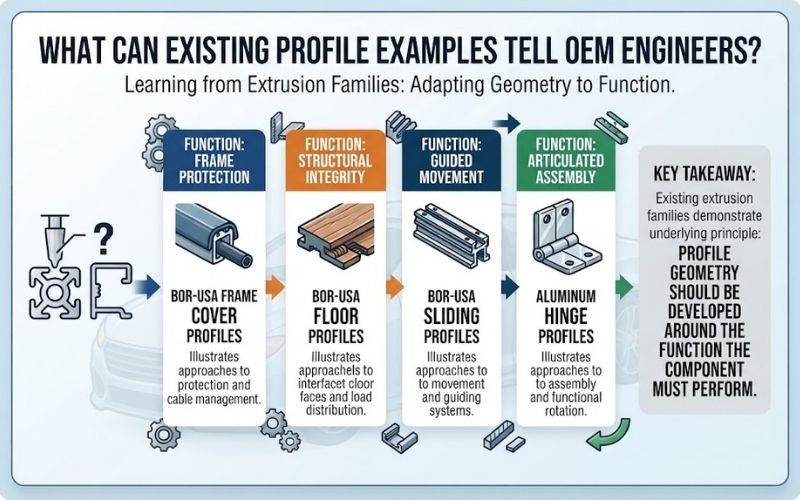
Existing extrusion families can also demonstrate how profile geometry is adapted to a specific function.
For example, BOR-USA’s frame cover profiles, floor profiles, sliding profiles and aluminum hinge profiles illustrate different approaches to interfaces, movement, protection and assembly.
These products are not automatically automotive components. Their relevance is the underlying extrusion principle: profile geometry should be developed around the function the component must perform.
Red Flags When Selecting an Automotive Aluminum Extrusion Supplier
Several warning signs should trigger additional technical or commercial investigation.
- The supplier focuses almost exclusively on price per kilogram.
- There is no clear process for reviewing profile manufacturability.
- Tooling ownership and maintenance are unclear.
- Dimensional inspection methods are not explained.
- Material traceability is inconsistent.
- Production capacity is described only in general terms.
- There is no defined engineering-change process.
- Secondary operations are outsourced without clear control.
- Quality documentation is unavailable or inconsistent.
- Lead times are quoted without considering tooling and finishing.
- The supplier cannot explain how production quality is maintained at higher volumes.
Procurement warning: A low initial quotation can become expensive if the supplier transfers engineering, machining, quality and logistics problems to the OEM after the purchase order.
Automotive Aluminum Extrusion Supplier Qualification Checklist
Before approving a supplier, an OEM procurement or engineering team can use the following checklist:
| Question | Pass / Review |
|---|---|
| Can the supplier manufacture the required profile geometry? | ☐ |
| Can the supplier support the required alloy and temper? | ☐ |
| Can the supplier review extrusion manufacturability? | ☐ |
| Are tooling ownership and maintenance clearly defined? | ☐ |
| Are dimensional inspection methods documented? | ☐ |
| Can the supplier support required secondary operations? | ☐ |
| Can the supplier meet expected annual production volume? | ☐ |
| Can the supplier provide required quality documentation? | ☐ |
| Can the supplier support engineering changes? | ☐ |
| Can the supplier support international delivery requirements? | ☐ |
| Has total landed cost been evaluated? | ☐ |
| Has the supplier demonstrated long-term production capability? | ☐ |
How BOR-USA Supports Automotive Aluminum Extrusion Projects
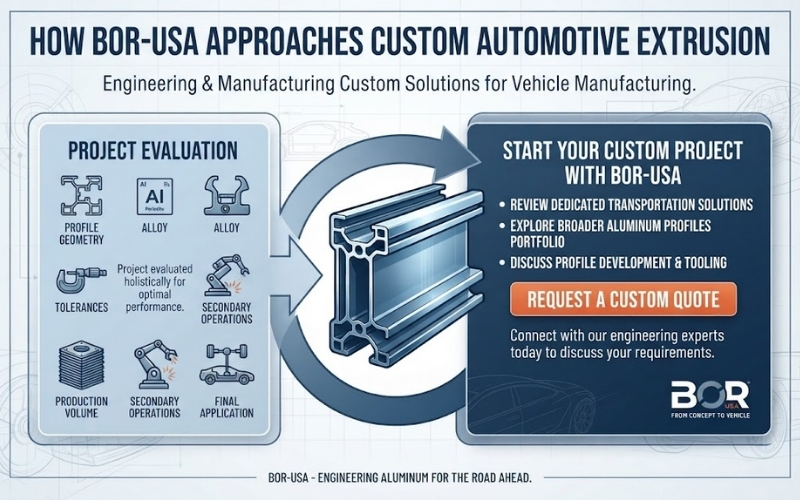
For automotive and transportation applications, BOR-USA approaches supplier support around the complete extrusion requirement rather than treating the profile as an isolated commodity.
The project can be evaluated around:
- Profile geometry
- Alloy and material requirements
- Extrusion feasibility
- Dimensional requirements
- Tooling
- Production volume
- Secondary processing
- Surface finishing
- Quality requirements
- International supply requirements
Companies developing transportation components can review the Transportation & Automotive Industry solutions or explore the broader aluminum profile portfolio.
For custom profile projects, the BOR-USA aluminum extrusion service provides the appropriate starting point for discussing profile geometry, tooling, production and technical requirements.
Looking for an Aluminum Extrusion Supplier for an Automotive OEM Project?
If you are evaluating suppliers for a new automotive component, do not compare manufacturers only by extrusion price. Share the profile drawing, CAD model, alloy requirements, tolerances, annual volume and application details so the complete manufacturing requirement can be evaluated.
BOR-USA can review your aluminum extrusion requirements and help determine the appropriate manufacturing route for the project.
Contact BOR-USA About Your Automotive Aluminum Extrusion Project
Final Takeaway
The right aluminum extrusion supplier for an automotive OEM is not simply the manufacturer offering the lowest profile price. It is the supplier capable of controlling the entire path from engineering design to repeatable serial production.
A proper supplier qualification should therefore examine extrusion capability, material expertise, tooling, dimensional control, secondary operations, quality documentation, capacity, logistics and total cost together.
When these factors are evaluated before supplier approval, OEMs can reduce the risk of late engineering changes, dimensional problems, production interruptions and unexpected downstream costs.
The best supplier is the one that can make the required profile consistently, document its quality, scale with the program and remain commercially reliable throughout the product lifecycle.
Frequently Asked Questions About Automotive Aluminum Extrusion Suppliers
What should an automotive OEM look for in an aluminum extrusion supplier?
An OEM should evaluate extrusion capability, alloy and temper knowledge, engineering support, tooling, dimensional control, secondary processing, quality documentation, production capacity, logistics and long-term supply reliability.
How do I compare automotive aluminum extrusion suppliers?
Compare suppliers using technical capability, quality control, tooling support, production capacity, secondary operations, lead time, documentation, logistics and total landed cost rather than price per kilogram alone.
Why is engineering support important when choosing an extrusion supplier?
Engineering support can identify manufacturability problems before tooling and production begin. It can also help optimize wall thickness, geometry, tolerances, alloy selection and downstream machining requirements.
What should an automotive aluminum extrusion RFQ include?
An RFQ should ideally include the 2D drawing, 3D CAD model, alloy and temper, tolerances, critical dimensions, profile length, annual volume, surface finish, machining requirements, inspection requirements, packaging and delivery requirements.
How important is extrusion die quality for automotive profiles?
Extrusion die design and condition directly affect the ability to produce the required profile geometry consistently. OEMs should therefore understand how the supplier handles die design, correction, maintenance and replacement.
Should I choose an aluminum extrusion supplier based on price per kilogram?
No. Price per kilogram is only one part of the cost. Tooling, machining, finishing, scrap, quality, packaging, logistics and assembly can significantly change the total cost of the finished component.
Can an aluminum extrusion supplier help optimize a custom profile?
A technically capable supplier can review the profile for manufacturability and identify potential improvements involving wall thickness, geometry, tolerances, hollow sections, machining and production requirements.
What quality documentation should an automotive extrusion supplier provide?
Depending on project requirements, documentation may include material certificates, alloy and temper information, dimensional inspection results, surface-finish records, batch traceability and nonconformance or corrective-action documentation.
How important is production capacity when selecting an automotive extrusion manufacturer?
Production capacity is critical because a supplier must be able to support both current requirements and potential increases when a vehicle program moves from prototype or pilot production into serial manufacturing.
Can BOR-USA supply aluminum extrusions for automotive and transportation applications?
Yes. BOR-USA provides aluminum extrusion solutions for transportation and automotive applications and can evaluate profile geometry, material requirements, tolerances, production volume and related manufacturing requirements.

Bor Aluminum – Content Producer