A custom aluminum extrusion is usually justified when integrating several functions into one optimized cross-section reduces machining, part count, assembly time, weight or lifecycle cost enough to offset the initial tooling and development expense.
This decision becomes increasingly relevant in vehicle structures, EV components, thermal-management systems, commercial vehicles and other transportation applications where lightweight construction and repeatable manufacturing are important. The Aluminum Association identifies automotive lightweighting and electrification as major drivers for aluminum use, while extrusion is one of the aluminum forming processes used for transportation components.


When Does a Custom Aluminum Extrusion Make Sense?

A custom extrusion becomes commercially attractive when the profile geometry itself solves a manufacturing or engineering problem that would otherwise require additional components or operations.
Typical indicators include:
- The required cross-section does not exist as a standard profile.
- A standard profile requires extensive CNC machining.
- Multiple components can be integrated into one extrusion.
- Weight needs to be reduced without sacrificing required stiffness.
- Mounting, sealing or fastening features must be integrated into the profile.
- The application requires a specific wall-thickness distribution.
- Large production volumes can amortize tooling costs.
- Assembly time can be reduced through profile integration.
- A custom section can improve material utilization.
- The part geometry needs to remain consistent across high-volume production.
If none of these conditions apply, a standard aluminum profile may be the more economical solution. BOR-USA’s aluminum profile range can be evaluated first before moving to a fully customized extrusion.
Custom vs. Standard Aluminum Extrusion: The Real Decision
The choice should not be reduced to “custom is better” or “standard is cheaper.” The correct decision depends on the complete manufacturing route.
| Decision Factor | Standard Profile | Custom Extrusion |
|---|---|---|
| Initial tooling investment | Low or none | Required |
| Profile geometry | Predefined | Application-specific |
| Material optimization | Limited | High |
| Integrated mounting features | Usually limited | Can be designed into section |
| Machining requirement | May be higher | Can often be reduced |
| Part consolidation | Limited | Often possible |
| High-volume economics | Good | Potentially excellent |
| Design flexibility | Limited | High |
The key is to compare the total manufactured part cost, not only the extrusion price per kilogram.
Why Automotive Parts Often Benefit From Custom Extrusion

Automotive components frequently combine structural, mounting, sealing, thermal and assembly requirements within a relatively small part.
A standard profile may satisfy the basic structural requirement but leave the manufacturer with several secondary operations. These can include drilling, milling, cutting, welding, fastening or adding separate brackets.
A custom extrusion can move some of those functions into the cross-section itself.
For example, an extrusion can potentially incorporate:
- Mounting channels
- Fastener locations
- Ribs for increased section stiffness
- Hollow chambers for weight reduction
- Sealing interfaces
- Guide channels
- Joining features
- Cooling channels
- Cover interfaces
- Locating surfaces
This is where extrusion design becomes more than a material-selection decision. It becomes a part-integration strategy.
How Profile Geometry Can Change the Economics
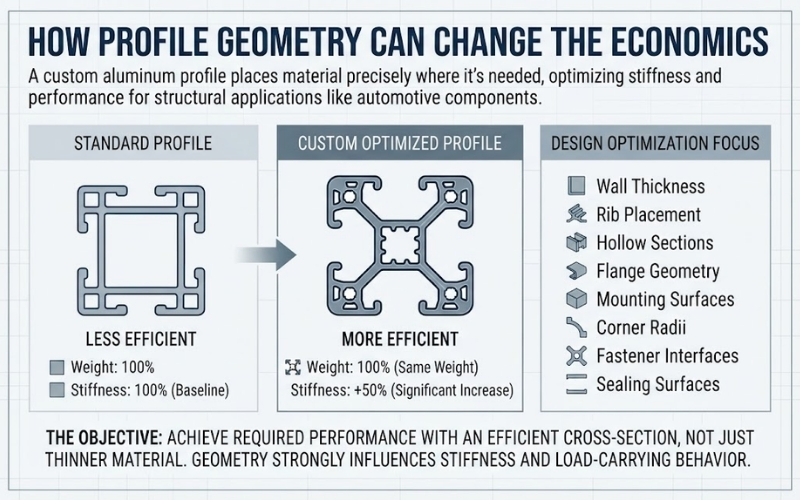
Two aluminum profiles with the same weight per meter can have very different engineering performance because their material is distributed differently.
A custom profile can place material where it contributes most effectively to the required section properties while removing unnecessary material elsewhere.
Depending on the application, engineers may optimize:
- Wall thickness
- Rib placement
- Hollow sections
- Flange geometry
- Mounting surfaces
- Corner radii
- Fastener interfaces
- Sealing surfaces
The objective is not simply to make the extrusion thinner. The objective is to achieve the required mechanical performance with an efficient cross-section.
For structural automotive components, this distinction matters because section geometry can strongly influence stiffness and load-carrying behavior. A lighter section is not automatically a better section if it creates excessive deflection or instability.
When a Custom Extrusion Can Reduce Machining
One of the strongest commercial reasons to develop a custom extrusion is the reduction of downstream machining.
Consider a standard profile that requires:
- Cutting to length
- CNC milling
- Drilling multiple mounting holes
- Adding separate brackets
- Installing fasteners
- Final assembly
A custom profile may allow some of these requirements to be incorporated into the extrusion geometry.
That does not mean machining disappears completely. Automotive components frequently require secondary fabrication. However, reducing the number, complexity or length of machining operations can materially affect production economics at scale.
The Aluminum Association notes that extrusions commonly undergo additional operations such as cutting, punching, machining, bending or welding before becoming finished components. This makes extrusion design and downstream fabrication decisions closely connected. See the Aluminum Association’s extrusion processing overview.
Custom Extrusion and Part Consolidation
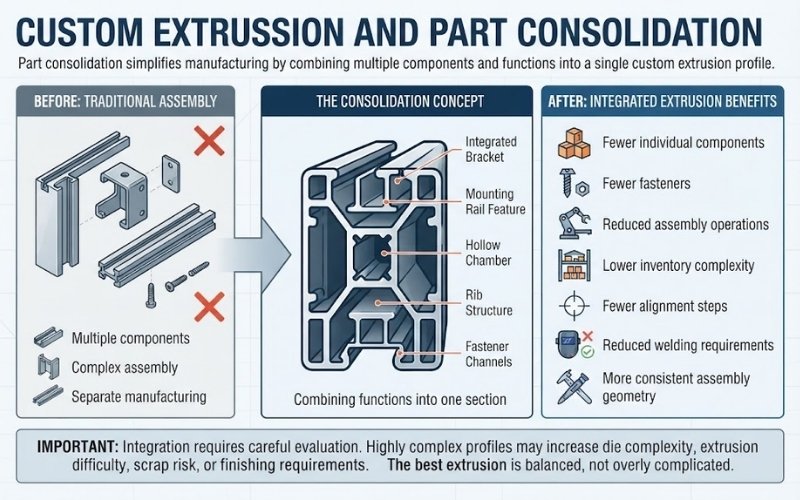
Part consolidation is another important reason to consider a custom extrusion.
Instead of manufacturing a profile, bracket and mounting rail separately, the extrusion can sometimes combine several interfaces into one section.
The potential benefits include:
- Fewer individual components
- Fewer fasteners
- Reduced assembly operations
- Lower inventory complexity
- Fewer alignment steps
- Reduced welding requirements
- More consistent assembly geometry
However, integration should be evaluated carefully. A highly complex profile may increase die complexity, extrusion difficulty, scrap risk or finishing requirements. The best custom extrusion is not necessarily the most complicated extrusion.
How Production Volume Changes the Custom Extrusion Decision

Production volume is one of the most important commercial variables in custom extrusion economics.
The initial tooling investment is distributed across the production quantity. As annual volume increases, the tooling cost allocated to each part generally becomes smaller.
A simplified model is:
Effective tooling cost per part = Initial tooling and development cost ÷ Expected lifetime production quantity
For example, a custom extrusion with a significant tooling investment may be difficult to justify for a prototype or very small production run. The same tooling can become economically attractive when the component is produced continuously over several years.
But volume alone does not determine the answer. The analysis should also include:
- Extrusion weight per meter
- Material price
- Cutting cost
- Machining cost
- Finishing cost
- Secondary fabrication
- Assembly labor
- Scrap rate
- Tooling maintenance
- Logistics
- Quality-control requirements
A Better Way to Calculate Custom Automotive Part Extrusion ROI
A common purchasing mistake is to compare only the price per kilogram of the custom profile against a standard profile.
A more useful calculation compares the complete cost of producing the finished component.
| Cost Element | Standard Profile Route | Custom Extrusion Route |
|---|---|---|
| Profile material | Included | Included |
| Tooling | Usually none | Initial investment |
| Cutting | Required | Required |
| CNC machining | Potentially high | Potentially reduced |
| Additional brackets | Potentially required | May be integrated |
| Fasteners | Potentially higher | Potentially reduced |
| Assembly | Potentially higher | Potentially reduced |
| Scrap/material efficiency | Depends on design | Can be optimized |
| Total component cost | Must be calculated | Must be calculated |
The correct question is therefore:
Does the custom extrusion reduce the total cost of the finished component enough to recover the tooling and development investment?
This is the central commercial test for custom extrusion.
When Automotive Custom Extrusion Is Usually Worth the Investment
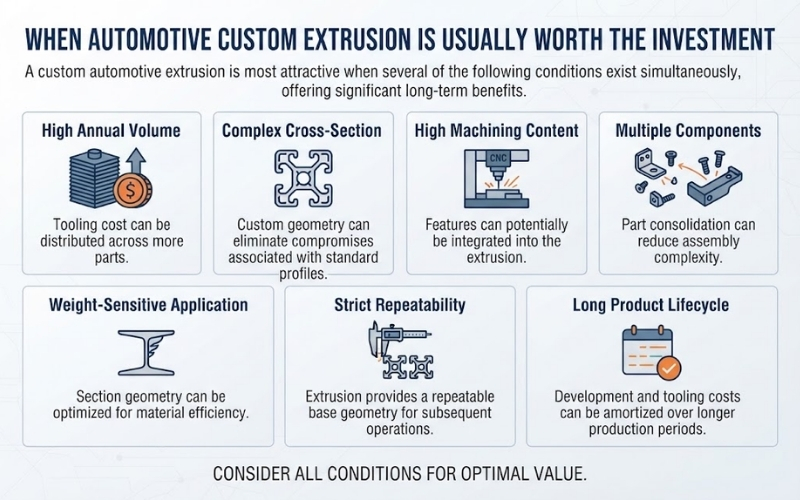
A custom automotive extrusion becomes particularly attractive when several of the following conditions exist simultaneously:
| Condition | Why It Supports Custom Extrusion |
|---|---|
| High annual volume | Tooling cost can be distributed across more parts. |
| Complex cross-section | Custom geometry can eliminate compromises associated with standard profiles. |
| High machining content | Features can potentially be integrated into the extrusion. |
| Multiple components | Part consolidation can reduce assembly complexity. |
| Weight-sensitive application | Section geometry can be optimized for material efficiency. |
| Strict repeatability | Extrusion provides a repeatable base geometry for subsequent operations. |
| Long product lifecycle | Development and tooling costs can be amortized over longer production periods. |
When a Standard Aluminum Profile May Be Better for Automotive Parts
Custom extrusion is not automatically the correct choice.
A standard profile can be more appropriate when:
- Annual demand is low.
- The application is temporary or prototype-oriented.
- The required geometry already exists.
- Machining requirements are minimal.
- There is no meaningful part-consolidation opportunity.
- Tooling investment cannot be justified.
- The component is not volume-sensitive.
In these cases, reviewing available standard aluminum profiles before commissioning a custom die can shorten development time and reduce initial cost.
How to Decide: A Practical Custom Automotive Aluminum Extrusion Decision Method

OEM engineers and procurement teams can use the following sequence before requesting a custom extrusion quotation.
Step 1: Define the Functional Requirement
Start with the part’s actual function rather than its desired appearance.
Identify:
- Loads
- Deflection limits
- Available envelope
- Required interfaces
- Operating environment
- Temperature range
- Joining method
- Required surface finish
Step 2: Search Existing Standard Profiles
Check whether an existing profile already meets the fundamental requirements.
If a standard profile can perform the function with limited secondary processing, custom tooling may not provide enough economic benefit.
Step 3: Quantify Secondary Operations
Calculate the real cost of machining, drilling, welding, brackets, fasteners and assembly.
This is often where the business case for custom extrusion becomes visible.
Step 4: Identify Integratable Features
Determine which features could be moved from secondary operations into the extrusion cross-section.
Typical examples include channels, ribs, mounting surfaces, locating features, covers and sealing interfaces.
Step 5: Estimate Annual and Lifetime Volume
Do not evaluate tooling against one purchase order only. Consider the expected production volume over the complete program lifecycle.
Step 6: Compare Total Cost
Compare the complete standard-profile route with the complete custom-extrusion route.
The winning solution is the one that provides the required technical performance at the lowest practical total cost, not necessarily the lowest extrusion price.
How EV Applications Change the Calculation
Electric vehicle platforms introduce additional opportunities for custom extrusion because packaging, weight, thermal management and structural integration often have to be considered simultaneously.
The Aluminum Association reports continued growth in aluminum use across electric vehicles and identifies applications including battery housings, e-motors, drives and structural components as important areas for aluminum adoption.
For these applications, a custom extrusion may be valuable when the profile can combine structural support with another function.
Examples include:
- Battery enclosure components
- Cooling channels
- Motor housings and supports
- Structural rails
- Mounting members
- Protective sections
- Thermal-management components
However, EV applications also require careful consideration of tolerances, joining, sealing, thermal expansion, corrosion compatibility and manufacturing repeatability. Customization should therefore begin with the complete system requirement rather than the extrusion die alone.
How Custom Extrusion Design Affects Automotive Parts Manufacturing
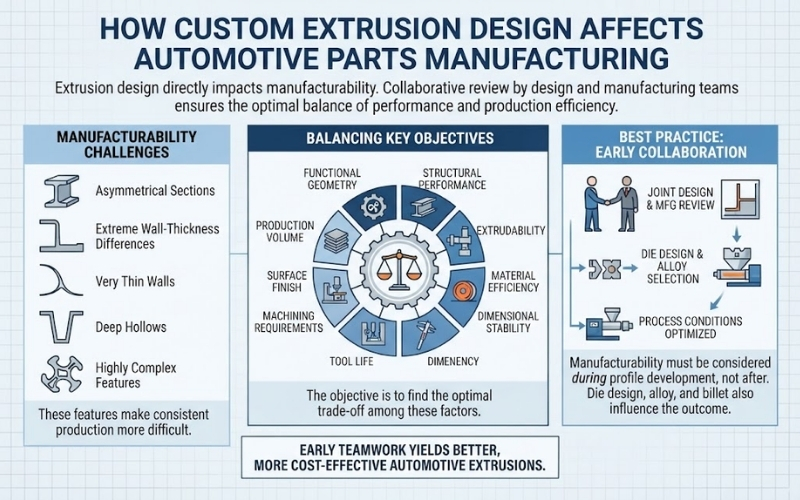
Extrusion design directly affects manufacturability.
Asymmetrical sections, extreme wall-thickness differences, very thin walls, deep hollows and highly complex features can make an extrusion more difficult to produce consistently.
For this reason, the profile should be reviewed jointly by the design and manufacturing teams before finalizing the die.
The objective is to find the best balance between:
- Functional geometry
- Structural performance
- Extrudability
- Material efficiency
- Dimensional stability
- Tool life
- Machining requirements
- Surface finish
- Production volume
The Aluminum Association also notes that die design, alloy, billet and process conditions all influence the extrusion process, reinforcing why manufacturability should be considered during profile development rather than after the design is completed.
What About Secondary Operations?
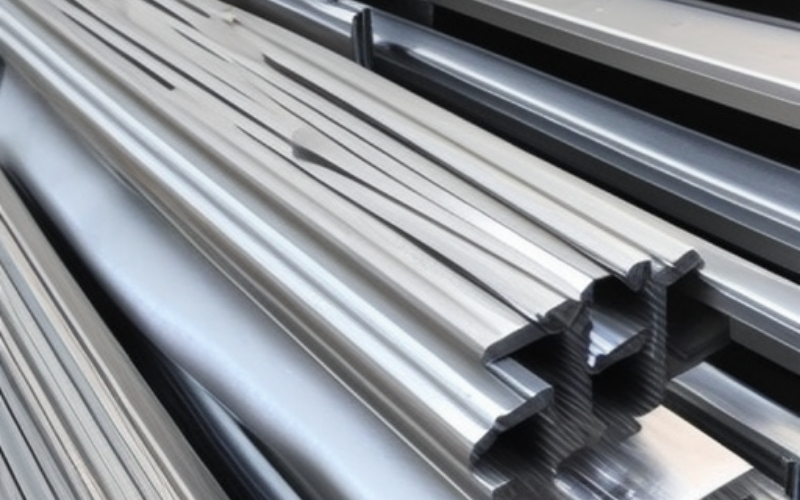
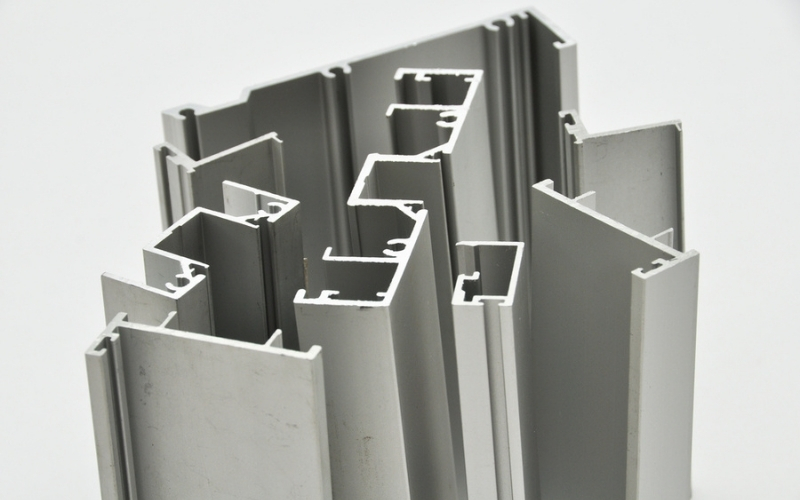
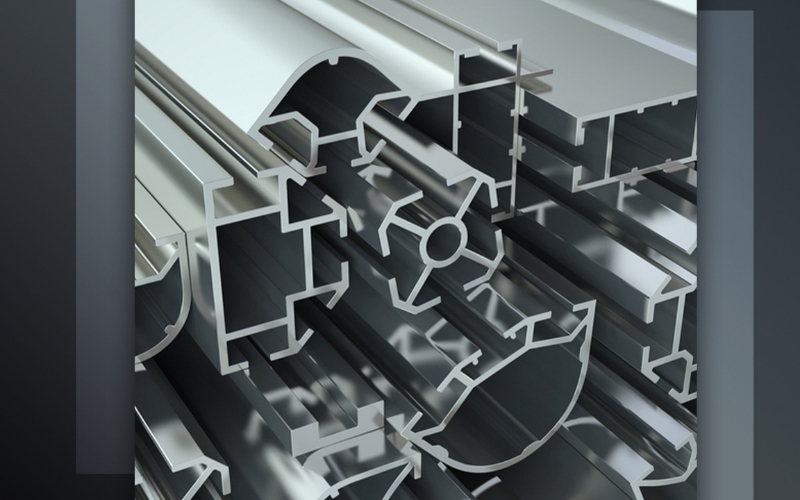

Most automotive extrusions are not finished components immediately after leaving the extrusion press.
Depending on the application, the profile may require:
- Precision cutting
- CNC machining
- Drilling
- Punching
- Bending
- Welding
- Anodizing
- Powder coating
- Assembly
Therefore, custom extrusion design should be developed together with the intended downstream process.
A profile that is slightly more expensive at the extrusion stage may still be cheaper overall if it substantially reduces CNC machining or assembly operations.
Not Every Aluminum Profile Needs to Be Automotive-Specific
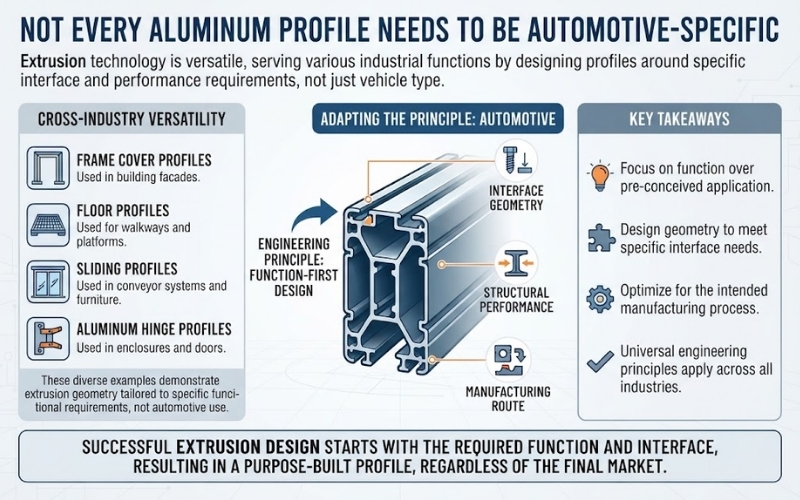
An important design principle is that the same extrusion technology can serve different industrial functions.
For example, BOR-USA’s existing portfolio includes specialized profiles such as frame cover profiles, floor profiles, sliding profiles and aluminum hinge profiles.
These examples are not automatically automotive parts. Their relevance is that they demonstrate how extrusion geometry can be developed around a specific interface or functional requirement.
In an automotive project, the same engineering principle applies: the profile should be designed around the required function, interface and manufacturing route.
What Should an Automotive OEM Provide for a Custom Extrusion Project?
A productive quotation process starts with accurate technical information.
An RFQ package should ideally include:
- 2D profile drawing
- 3D CAD model where available
- Required alloy and temper, if already defined
- Dimensional tolerances
- Critical-to-function dimensions
- Required length
- Annual volume
- Expected program lifetime
- Surface finish
- Machining requirements
- Joining requirements
- Packaging requirements
- Inspection requirements
- Target application
- Prototype and production requirements
If the alloy, temper or extrusion geometry has not yet been finalized, the manufacturer should receive enough application information to participate in the engineering evaluation.
How BOR-USA Approaches Custom Automotive Extrusion for Automotive Parts
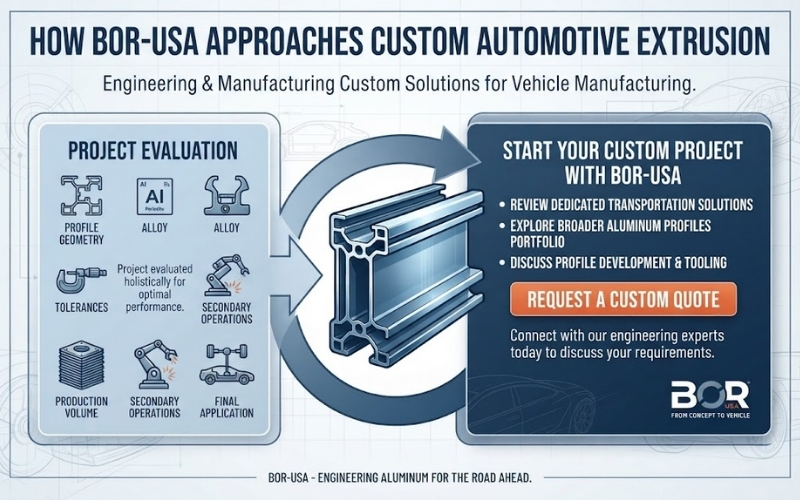
BOR-USA approaches aluminum extrusion as an engineering and manufacturing process rather than simply supplying aluminum by weight.
For automotive and transportation applications, the project should be evaluated around the relationship between profile geometry, alloy, tolerances, production volume, secondary operations and final application requirements.
Companies evaluating automotive aluminum profiles can review the dedicated Transportation & Automotive Industry aluminum extrusion solutions and the broader aluminum profiles portfolio.
For projects requiring a custom section, BOR-USA’s aluminum extrusion service can be used as the starting point for discussing profile development, tooling and production requirements.
Need a Custom Aluminum Extrusion for an Automotive Part?
If your automotive component requires a non-standard cross-section, integrated mounting features, weight optimization or reduced machining, the next step is to evaluate the complete manufacturing requirement—not just the profile price.
Send BOR-USA your drawing, CAD file, target dimensions, annual volume and application requirements. The technical team can then evaluate whether a custom extrusion is commercially and technically justified.
Contact BOR-USA for a Custom Extrusion Project
Final Takeaway
Custom aluminum extrusion becomes worthwhile when the customized cross-section creates measurable value beyond what a standard profile can provide.
The strongest business cases usually combine several advantages: reduced machining, fewer components, lower assembly effort, optimized weight, integrated interfaces and sufficient production volume to amortize tooling.
For automotive OEMs and Tier suppliers, the right evaluation therefore starts with the finished component and works backward toward the extrusion process.
If the custom profile improves the complete manufacturing route—not just the extrusion itself—it can become a cost-reduction and performance-optimization tool rather than simply an additional tooling expense.
Frequently Asked Questions About Custom Automotive Aluminum Extrusions
When is a custom aluminum extrusion worth the cost?
A custom aluminum extrusion is usually worth considering when its geometry can reduce machining, part count, assembly time, weight or total component cost enough to justify tooling and development expenses.
Is custom extrusion cheaper than using a standard aluminum profile?
Not necessarily at the initial purchase stage. A standard profile may have a lower upfront cost, while a custom extrusion can provide a lower total cost when production volume, machining, assembly and material efficiency are considered.
Does production volume affect custom aluminum extrusion cost?
Yes. Higher production volume generally allows the initial tooling and development investment to be distributed across more parts, improving the economics of a custom extrusion program.
Can custom extrusion reduce CNC machining for automotive parts?
Yes. Mounting channels, ribs, locating surfaces and other repeated features can sometimes be incorporated into the extrusion geometry, reducing the amount of downstream machining required.
Can custom aluminum extrusions reduce the number of automotive components?
Yes. A well-designed extrusion can combine structural and mounting functions that would otherwise require separate brackets, rails or fastening components.
Are custom aluminum extrusions suitable for EV components?
Yes. Custom extrusions can be used where lightweight structural geometry, thermal management, mounting, sealing or repeated cross-sections are required in EV systems. The final design must be evaluated against the application’s mechanical, thermal, dimensional and joining requirements.
What information is needed for a custom automotive extrusion quotation?
A useful RFQ normally includes the profile drawing or CAD model, alloy and temper if known, tolerances, dimensions, length, annual volume, application, surface finish, machining requirements and expected production lifecycle.
Should an automotive OEM choose custom extrusion or CNC machining?
The answer depends on geometry and production requirements. Extrusion is particularly attractive for long components with a repeated cross-section, while CNC machining can be more suitable for highly localized or non-repeating geometries. A hybrid extrusion-plus-machining process can also be effective.
Can BOR-USA manufacture custom aluminum extrusions for automotive applications?
Yes. BOR-USA provides aluminum extrusion solutions for transportation and automotive applications and can evaluate custom profile requirements based on geometry, alloy, tolerances, production volume and application requirements.

Bor Aluminum – Content Producer